Trail & River Advisory
Rainy Day Trekking in Bukit Lawang: Safety & River Rules
Click to enlarge

Gunung Leuser National Park is an equatorial tropical rainforest—and as the name promises, rain is the lifeblood of the ecosystem. Even during the relatively drier months of May through September, warm convective clouds building over the Bukit Barisan mountains frequently release a 45-to-90-minute afternoon downpour.

Many visitors worry: "Will my trek be canceled if it rains, do wild orangutans disappear during a storm, and is Bohorok River tubing still safe after heavy upstream rainfall?" This field guide explains how wildlife behaves when the canopy gets wet, our 3-tier HPI Trail & River Safety Protocol, and our transparent fair-weather rescheduling policy.

€
Guide rates in this article are displayed in: EUR (€) Automatically converted from standard HPI Langkat reference tariffs (Base: EUR).
Switch currency in top header

1. How Tropical Rainforest Showers Actually Work in Bukit Lawang

Unlike temperate mid-latitude weather fronts that bring freezing, all-day gray drizzle for days on end, equatorial rainfall in North Sumatra follows a remarkably predictable diurnal rhythm:

  • Clear, Crisp Mornings (07:00 – 13:00 WIB): Nearly 80% of days in Bukit Lawang begin with bright sunshine or misty golden light filtering through the dipterocarp canopy. This is why all our 1-Day Discovery Treks and 2D1N Overnight Camps depart promptly at 08:30 WIB—giving you 4 to 5 hours of prime dry-morning primate tracking before afternoon clouds build.
  • Warm Afternoon Convective Showers (14:30 – 17:00 WIB): When it does rain, the ambient temperature remains a warm 25°C to 27°C. Beneath the dense 40-meter multi-layered forest canopy, light rain takes 15 minutes just to drip through the upper leaves to the forest floor!
  • Nocturnal Rain (21:00 – 04:00 WIB): During the wetter months (October–January), most heavy rainfall occurs overnight while you are tucked securely beneath our double-tarpaulin riverside camp shelters, clearing up by dawn as the gibbons begin singing.
Check Today’s Trail & River Advisory: Before lacing up your shoes, check the latest guide river report, mud traction ratings, and ranger advisories on our Trail & River Advisory page.

2. What Do Wild Orangutans & Monkeys Do When It Rains?

Seeing a tropical shower in Gunung Leuser often triggers one of the most endearing wildlife behaviors in the animal kingdom:

  1. Orangutan "Leaf Umbrellas" & Day Nests: Wild Sumatran orangutans dislike getting soaked just as much as humans do! When a heavy shower starts, an orangutan will snap off two or three giant wild banana leaves or broad Macaranga / dipterocarp branches and hold them directly over its head like a green umbrella—or weave a quick overhead roof over its branch fork and wait patiently for the rain to pass.
  2. Why Post-Rain Tracking is Phenomenal: During a shower, primates stay stationary in a single tree rather than traveling rapidly across the canopy. Once the rain stops and steam rises from the jungle floor, orangutans, Thomas’s Leaf Monkeys, and Rhinoceros Hornbills emerge immediately to shake off their fur/feathers and feed actively.
  3. Land Leech Activity After Rain: Damp leaf litter brings out harmless land leeches (pacet). Wearing canvas anti-leech socks tucked over your pants keeps your ankles thoroughly protected.

3. Our 3-Tier HPI Trail & River Safety Protocol (Green / Amber / Red)

Tropical rainforest weather is dynamic, and since the historic 2003 Bohorok watershed event, Bukit Lawang’s HPI guide collective and Balai Besar TNGL rangers operate a strict, non-negotiable 3-tier safety system:

Advisory Level Weather & Upstream River Condition Jungle Trail Protocol Bohorok River Tubing Status
🟢 GREEN (Normal / Light Shower) Dry morning or standard brief afternoon tropical shower; clear emerald river flow All primary ridges & riverside trails open as scheduled Fully Open with experienced local skippers, life vests & helmets
🟡 AMBER (Heavy Sustained Rain) Sustained rain >90 mins; clay slopes slick; Bohorok river turns turbid brown & rises Guides reroute away from steep 35° clay chutes onto gentler terraced ridge paths; avoid resting beneath dead trees Paused / Walk-Back Contingency: If river debit exceeds safe thresholds, guests walk back along the flat riverside path
🔴 RED (Severe Storm / Ranger Closure) High winds (falling branch hazard) or upstream flash-flood warning from TNGL rangers Morning departures delayed until storm clears or rescheduled to the next morning at zero fee Strictly Closed until water gauge returns to Green

4. What Happens to Your River Tubing Return If the River Rises?

The Bohorok River Tube Rafting ("Jungle Taxi") finale is a highlight of our 1-Day and Multi-Day treks. However, river safety is never compromised for convenience:

  • How Guides Read the River: Even if it is sunny in Bukit Lawang village, heavy rain 15 kilometers upstream in the high mountains of Gunung Leuser can cause the Bohorok River to rise and change color from clear green-tea to muddy brown-coffee accompanied by floating twigs.
  • The Safe Land-Trail Alternative: If our river captains and Lead HPI Guide determine that the afternoon water gauge exceeds safe Grade I–II tubing limits, we pack the rafts away and walk back along the shaded, flat 40-minute riverbank footpath to the village. If you paid for a standalone tubing add-on that could not run due to river levels, that portion is rescheduled or refunded transparently.

5. 4 Smart Rain-Proofing Hacks for Every Trekker

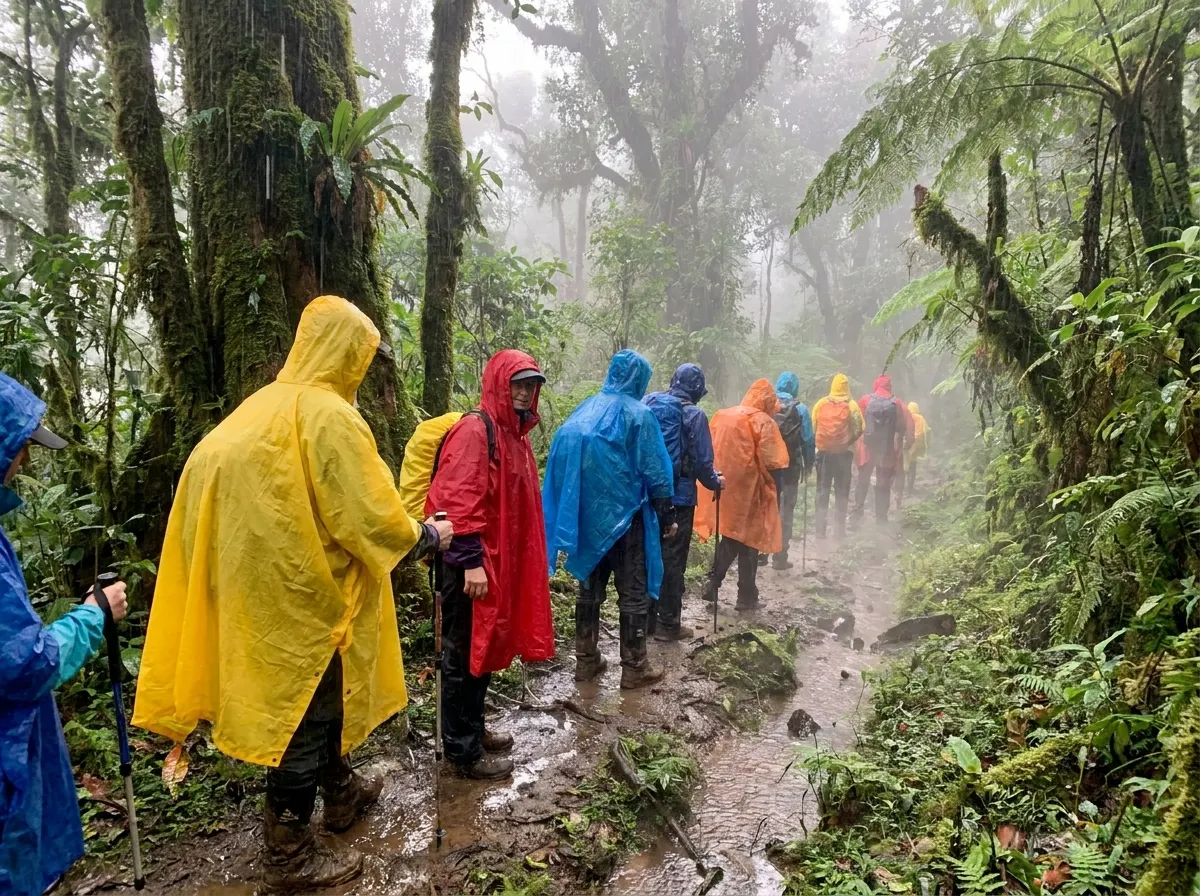
  1. Pack a Loose €2 Rain Poncho Instead of a Heavy Gore-Tex Jacket: In 28°C heat and 90% humidity, a zip-up waterproof hardshell jacket traps sweat inside until you are just as wet from perspiration as from the rain. A lightweight, loose poncho fits right over both you and your 20L daypack while letting cool air circulate underneath.
  2. Double-Line Your Daypack with a Dry Bag: Even if your backpack has an outer rain cover, water can seep through the shoulder-strap stitching during a tropical downpour. Seal your phone, camera, and dry camp sleeping clothes inside a 5L–10L roll-top dry bag or heavy-duty Ziploc inside your pack (Full Packing Guide).
  3. Wear Fast-Drying Footwear: Choose non-Gore-Tex lugged trail runners or local studded rubber Sepatu Getah (€4 in the village) that drain and dry immediately after rain.
  4. Never Grab Unknown Vines When Slipping on Wet Clay: Many climbing palms in Gunung Leuser are rattan (rotan) covered in needle-sharp recurved spines. Let your HPI guide point out solid smooth roots or offer you a hand on muddy steps.

Check Live Weather & Trail Conditions Anytime: Bookmark our Trail & River Advisory and our Month-by-Month Weather & Fruiting Planner before your trek!
Share This Guide With Your Travel Partner Planning a Sumatra expedition together?
WhatsApp Facebook X Telegram Email
Explore Bukit Lawang Team
Verified Guide & Author • 15+ Years in Leuser

Explore Bukit Lawang Team

HPI Member Guides, Wildlife Naturalists & Conservation Collective

The editorial and expedition team of Explore Bukit Lawang — local HPI member guides, primate trackers, river captains and conservation educators born along the Bohorok River.

Experience Gunung Leuser In Person

Ready to Trek with Our Local HPI Guides?

National park permits, small private groups, and traditional river tubing included on every expedition.


Trekking Guides • 9 min read • 67 views • November 09, 2026
Rainy Day Trekking in Bukit Lawang: Safety & River Rules

What happens when it rains during your Bukit Lawang jungle trek? Learn how orangutans behave in rain, HPI trail advisories & Bohorok river tubing safety.

Explore Bukit Lawang Team
Explore Bukit Lawang Team HPI Member Guides, Wildlife Naturalists & Conservation Collective

Gunung Leuser National Park is an equatorial tropical rainforest—and as the name promises, rain is the lifeblood of the ecosystem. Even during the relatively drier months of May through September, warm convective clouds building over the Bukit Barisan mountains frequently release a 45-to-90-minute afternoon downpour.

Many visitors worry: "Will my trek be canceled if it rains, do wild orangutans disappear during a storm, and is Bohorok River tubing still safe after heavy upstream rainfall?" This field guide explains how wildlife behaves when the canopy gets wet, our 3-tier HPI Trail & River Safety Protocol, and our transparent fair-weather rescheduling policy.

€
Guide rates in this article are displayed in: EUR (€) Automatically converted from standard HPI Langkat reference tariffs (Base: EUR).
Switch currency in top header

1. How Tropical Rainforest Showers Actually Work in Bukit Lawang

Unlike temperate mid-latitude weather fronts that bring freezing, all-day gray drizzle for days on end, equatorial rainfall in North Sumatra follows a remarkably predictable diurnal rhythm:

  • Clear, Crisp Mornings (07:00 – 13:00 WIB): Nearly 80% of days in Bukit Lawang begin with bright sunshine or misty golden light filtering through the dipterocarp canopy. This is why all our 1-Day Discovery Treks and 2D1N Overnight Camps depart promptly at 08:30 WIB—giving you 4 to 5 hours of prime dry-morning primate tracking before afternoon clouds build.
  • Warm Afternoon Convective Showers (14:30 – 17:00 WIB): When it does rain, the ambient temperature remains a warm 25°C to 27°C. Beneath the dense 40-meter multi-layered forest canopy, light rain takes 15 minutes just to drip through the upper leaves to the forest floor!
  • Nocturnal Rain (21:00 – 04:00 WIB): During the wetter months (October–January), most heavy rainfall occurs overnight while you are tucked securely beneath our double-tarpaulin riverside camp shelters, clearing up by dawn as the gibbons begin singing.
Check Today’s Trail & River Advisory: Before lacing up your shoes, check the latest guide river report, mud traction ratings, and ranger advisories on our Trail & River Advisory page.

2. What Do Wild Orangutans & Monkeys Do When It Rains?

Seeing a tropical shower in Gunung Leuser often triggers one of the most endearing wildlife behaviors in the animal kingdom:

  1. Orangutan "Leaf Umbrellas" & Day Nests: Wild Sumatran orangutans dislike getting soaked just as much as humans do! When a heavy shower starts, an orangutan will snap off two or three giant wild banana leaves or broad Macaranga / dipterocarp branches and hold them directly over its head like a green umbrella—or weave a quick overhead roof over its branch fork and wait patiently for the rain to pass.
  2. Why Post-Rain Tracking is Phenomenal: During a shower, primates stay stationary in a single tree rather than traveling rapidly across the canopy. Once the rain stops and steam rises from the jungle floor, orangutans, Thomas’s Leaf Monkeys, and Rhinoceros Hornbills emerge immediately to shake off their fur/feathers and feed actively.
  3. Land Leech Activity After Rain: Damp leaf litter brings out harmless land leeches (pacet). Wearing canvas anti-leech socks tucked over your pants keeps your ankles thoroughly protected.

3. Our 3-Tier HPI Trail & River Safety Protocol (Green / Amber / Red)

Tropical rainforest weather is dynamic, and since the historic 2003 Bohorok watershed event, Bukit Lawang’s HPI guide collective and Balai Besar TNGL rangers operate a strict, non-negotiable 3-tier safety system:

Advisory Level Weather & Upstream River Condition Jungle Trail Protocol Bohorok River Tubing Status
🟢 GREEN (Normal / Light Shower) Dry morning or standard brief afternoon tropical shower; clear emerald river flow All primary ridges & riverside trails open as scheduled Fully Open with experienced local skippers, life vests & helmets
🟡 AMBER (Heavy Sustained Rain) Sustained rain >90 mins; clay slopes slick; Bohorok river turns turbid brown & rises Guides reroute away from steep 35° clay chutes onto gentler terraced ridge paths; avoid resting beneath dead trees Paused / Walk-Back Contingency: If river debit exceeds safe thresholds, guests walk back along the flat riverside path
🔴 RED (Severe Storm / Ranger Closure) High winds (falling branch hazard) or upstream flash-flood warning from TNGL rangers Morning departures delayed until storm clears or rescheduled to the next morning at zero fee Strictly Closed until water gauge returns to Green

4. What Happens to Your River Tubing Return If the River Rises?

The Bohorok River Tube Rafting ("Jungle Taxi") finale is a highlight of our 1-Day and Multi-Day treks. However, river safety is never compromised for convenience:

  • How Guides Read the River: Even if it is sunny in Bukit Lawang village, heavy rain 15 kilometers upstream in the high mountains of Gunung Leuser can cause the Bohorok River to rise and change color from clear green-tea to muddy brown-coffee accompanied by floating twigs.
  • The Safe Land-Trail Alternative: If our river captains and Lead HPI Guide determine that the afternoon water gauge exceeds safe Grade I–II tubing limits, we pack the rafts away and walk back along the shaded, flat 40-minute riverbank footpath to the village. If you paid for a standalone tubing add-on that could not run due to river levels, that portion is rescheduled or refunded transparently.

5. 4 Smart Rain-Proofing Hacks for Every Trekker

  1. Pack a Loose €2 Rain Poncho Instead of a Heavy Gore-Tex Jacket: In 28°C heat and 90% humidity, a zip-up waterproof hardshell jacket traps sweat inside until you are just as wet from perspiration as from the rain. A lightweight, loose poncho fits right over both you and your 20L daypack while letting cool air circulate underneath.
  2. Double-Line Your Daypack with a Dry Bag: Even if your backpack has an outer rain cover, water can seep through the shoulder-strap stitching during a tropical downpour. Seal your phone, camera, and dry camp sleeping clothes inside a 5L–10L roll-top dry bag or heavy-duty Ziploc inside your pack (Full Packing Guide).
  3. Wear Fast-Drying Footwear: Choose non-Gore-Tex lugged trail runners or local studded rubber Sepatu Getah (€4 in the village) that drain and dry immediately after rain.
  4. Never Grab Unknown Vines When Slipping on Wet Clay: Many climbing palms in Gunung Leuser are rattan (rotan) covered in needle-sharp recurved spines. Let your HPI guide point out solid smooth roots or offer you a hand on muddy steps.
Check Live Weather & Trail Conditions Anytime: Bookmark our Trail & River Advisory and our Month-by-Month Weather & Fruiting Planner before your trek!
You have reached the end of this field dispatch

Written by local HPI member guides from Bukit Lawang. If you have questions about packing, permits, or trail conditions, reach out anytime.

Chat with Guide on WhatsApp

Park Permit Assistance

Facilitated at Balai Besar TNGL checkpoints

Ethical Jungle Trekking

Zero feeding & 10m distance policy

Traditional River Tubing

Safety gear & skilled river captains

Works Fully Offline

Guides work deep inside rainforest