Worried about jungle leeches (pacet) in Bukit Lawang? Learn why land leeches carry zero disease, how anti-leech socks work & 4-step fingernail removal.
For many travelers planning their first rainforest trek in Bukit Lawang, the thought of encountering a tiny 2-centimeter land leech (locally called pacet) causes more anxiety than steep mountain ridges or wild primates. Movies have conditioned us to view jungle leeches with dread—yet biologically and clinically, terrestrial rainforest leeches are among the most harmless creatures in Gunung Leuser National Park.
This field guide is provided for educational and informational travel reference only and does not constitute formal medical advice, diagnosis, or prescription. Individual health conditions, medication tolerances, and prophylactic requirements vary. Always consult a certified travel medicine physician or licensed healthcare professional before departure regarding personal prescriptions, anti-malarial prophylaxis, allergy management, and vaccinations.
Understanding the science behind how land leeches behave, why they never transmit human diseases, how woven anti-leech socks block them mechanically, and how to detach one cleanly in 5 seconds using just your fingernail will turn leech anxiety into calm trail confidence. You can also download our printable A4 protocol sheet directly from our Interactive Rainforest First-Aid & Leech Bite Field Guide.
1. The Clinical Truth: Zero Disease Transmission & Why Bites Bleed
Let us start with the single most reassuring medical fact verified by tropical medicine specialists:
- Land Leeches Do Not Transmit Diseases: Unlike mosquitoes (which can carry dengue or malaria) or ticks (which can carry Lyme disease), terrestrial jawed land leeches (family Haemadipsidae) in Southeast Asian rainforests do not transmit any viruses, parasites, or blood-borne diseases to humans.
- Total Blood Loss Is Less Than 5 ml: An average ground leech consumes only
1 ml to 3 mlof blood before dropping off naturally after 20 to 30 minutes—roughly a fraction of a teaspoon. - Why Does a Leech Bite Keep Oozing Blood? When a leech attaches, its saliva injects a mild local anesthetic (which is why you almost never feel a ground leech bite) along with hirudin, a potent natural anticoagulant peptide that prevents blood platelets from clotting. After the leech is removed, the residual hirudin in the tiny Y-shaped skin puncture continues to ooze thin blood for 30 to 90 minutes. Mixed with sweat on a light-colored sock, a 2 ml ooze looks dramatic—even though the puncture itself is superficial and completely harmless.
2. Meet the Two Species of Leeches in Gunung Leuser
On the trails of Gunung Leuser National Park, our HPI guides distinguish between two local species of terrestrial leeches, each occupying a different forest microhabitat:
| Leech Species | Appearance & Size | Microhabitat in Gunung Leuser | Bite Sensation & Best Defense |
|---|---|---|---|
| 1. Ground Brown Leech (Haemadipsa sylvestris / Pacet Tanah) |
1.5 – 3 cm long; dark reddish-brown or mottled black; slender inchworm movement. |
Damp leaf litter, mossy logs, and shaded valley floors along the Bohorok & Landak watersheds. | Painless Bite (Natural Anesthetic): Crawls over shoes and slips through standard knit socks. Blocked by tight-weave canvas leech socks. |
| 2. Tiger / Tree Leech (Haemadipsa picta / Pacet Daun / Macan) |
2 – 3.5 cm long; vivid yellow, orange, and dark green longitudinal stripes. |
Understorey fern fronds and wet leaves at waist-to-shoulder height (0.5m–1.5m) in deeper primary forest after rain. |
Immediate Mild Sting: You feel a slight pinprick immediately as it attaches, making it easy to spot and flick off. Prevented by tucking shirts into trousers. |
3. Seasonality & Trail Depth: Will You Even See Leeches?
Whether you encounter leeches on your Bukit Lawang trek depends heavily on two factors—recent rainfall and trail elevation:
- Dry Season & Upper Sunlit Ridges (May to August & February): Land leeches dehydrate rapidly in dry air. During Peak Dry Season months or on sunny upper dipterocarp ridges (like those on our 3-Hour and 1-Day treks), hikers frequently complete their entire trek without seeing a single leech!
- Wet Season & Deep Shaded Valleys (September to January & Multi-Day Treks): After afternoon rainstorms or when trekking across damp primary rainforest basins toward Jamur Batu, Batu Gajah, or Bekail on 2D1N to 5D4N expeditions, leeches emerge on wet leaf litter to sense the carbon dioxide, body heat, and footstep vibrations of passing wildlife and hikers.
4. The 3-Layer Defense: How to Prevent 95% of Leech Bites
You do not need heavy chemical sprays to stay leech-free. Follow the same three-layer defense system used by Gunung Leuser field biologists and local rangers:
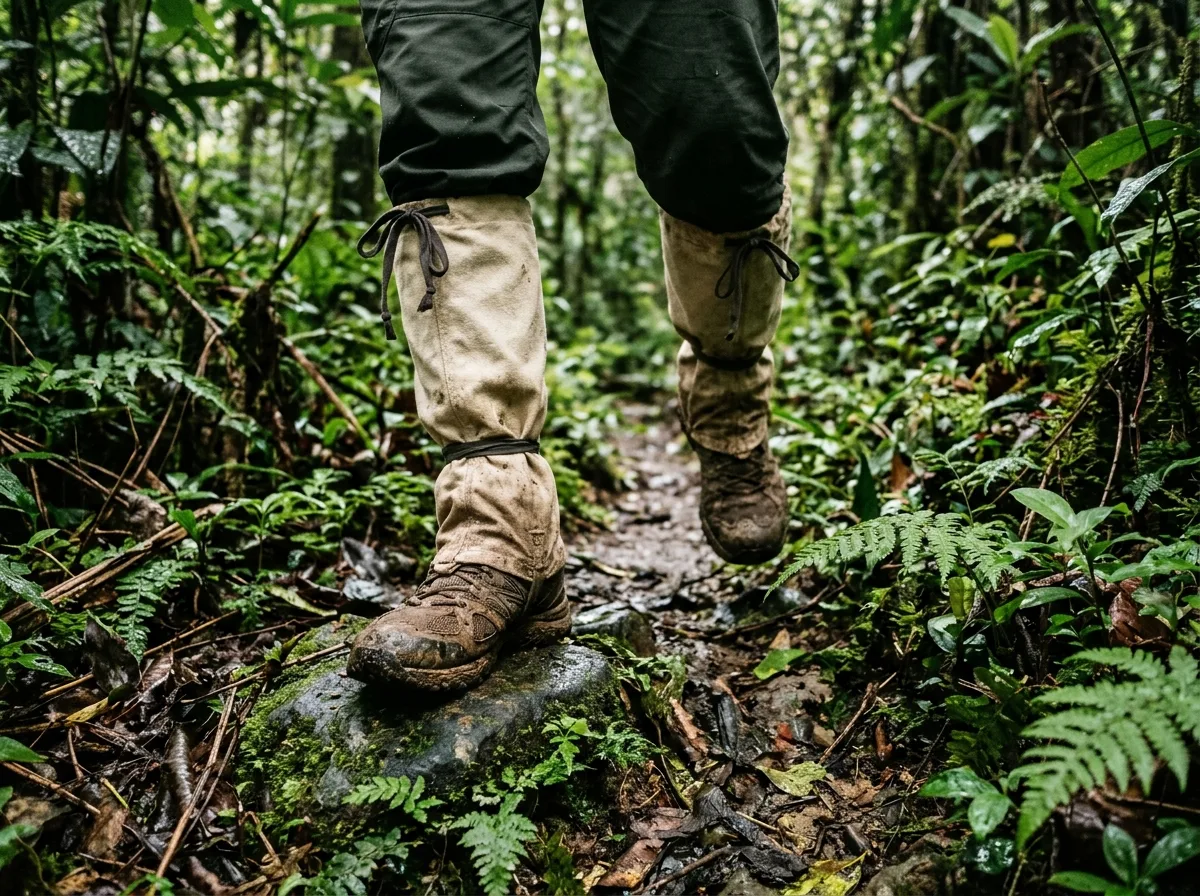
- Wear Tight-Weave Canvas Leech Socks (Kaos Kaki Pacet): Standard athletic or merino hiking socks have stretchy knit pores that a hungry, 1-millimeter-wide ground leech can squeeze right through. Dedicated anti-leech socks are knee-high oversocks sewn from tightly woven cotton/calico fabric that leeches cannot penetrate. Put on your normal sock, pull the canvas leech sock over your trousers up to just below your knee, tie the top drawstring snugly, and step into your trail shoes or Sepatu Getah.
- Apply Natural Cajuput Oil (Minyak Kayu Putih), Tiger Balm, or DEET to Shoe Cuffs: Leeches have sensitive chemoreceptors along their skin and strongly dislike eucalyptus/cajuput oil, menthol, citronella, tobacco water, and DEET. Rubbing a ring of Indonesian Minyak Kayu Putih or spraying 30% DEET around the outside of your shoe tongue and leech-sock cuff causes climbing leeches to curl up and drop off immediately.
- Smart Trail Stopping Habits: Ground leeches cannot jump or fly—they inch along the ground at a few centimeters per minute. As long as you are walking at a steady pace, they rarely manage to climb onto your boots. When stopping for a 15-minute wildlife observation break, stand on a dry tree root or rock rather than deep wet leaf litter, and do a quick 10-second boot check with your trekking buddy.
5. How to Remove an Attached Leech in 4 Safe Steps (Never Use Fire or Salt!)
If a leech does manage to bypass your socks and latch onto your ankle or wrist, stay calm. The only medical risk from a leech bite comes from improper removal:
CRITICAL MEDICAL WARNING — NEVER BURN, SALT, OR YANK AN ATTACHED LEECH: Never hold a cigarette lighter to an attached leech, pour salt on it, spray DEET directly onto its body while feeding, or yank it straight off by its tail. Extreme heat or chemical shock forces the leech to vomit its digestive bacteria (Aeromonas hydrophila) back into your open puncture wound, while forceful yanking can leave microscopic jaw teeth embedded in your skin—causing an itchy, slow-healing secondary infection.
Instead, use the clean, mechanical 4-Step Fingernail Slide Method practiced by all HPI guides and detailed in our Rainforest First-Aid Guide:
- Step 1 — Locate the Narrow Front Mouth Sucker: A feeding leech has two suction cups: a wider rear anchor foot and a narrower front mouth sucker pulsing gently against your skin.
- Step 2 — Slide Your Fingernail Sideways Under the Mouth: Place the flat edge of your fingernail (or a plastic bank card / ID card) flush against your skin right next to the narrow front mouth. Push gently sideways beneath the lip of the sucker to break the vacuum seal.
- Step 3 — Detach & Flick Off Immediately: Once the front mouth releases, slide your nail under the rear suction pad and flick the leech firmly onto the dirt trail (leeches are sticky and will try to loop onto your finger if you hold them!).
- Step 4 — Disinfect with Betadine & Apply Direct Pressure: Wipe the tiny puncture with an antiseptic Chlorhexidine wipe, dab a drop of Povidone Iodine (Betadine), and press a sterile gauze square or fabric plaster firmly over the spot for 10 to 15 minutes until the hirudin oozing clots.
6. Post-Trek Care: How to Stop the "Day 3 Leech Itch"
About 24 to 48 hours after a leech bite heals, the site often develops a localized histamine reaction similar to a mosquito bite—known among trekkers as the "Day 3 Leech Itch." Follow two golden rules:
- Never Scratch with Fingernails: In humid
85%tropical air, scratching a healed bite breaks the skin barrier and introduces Staphylococcus bacteria from under your fingernails. - Apply Soothing Balm or Oral Antihistamine: Dab Tiger Balm, Minyak Kayu Putih, or hydrocortisone 1% cream onto the spot, or ask a pharmacist about a suitable non-drowsy antihistamine.
7. Local Gear Costs & Trekking Package Reference
Forgot to pack leech socks or Betadine before flying to Sumatra? Every item is available in Bukit Lawang village for just a few Euros, and our HPI member guides always carry a field first-aid kit on every trek:
| Item / Trekking Package | Where to Get & Field Notes | Standard Rate (EUR) | Approx. Benchmark (IDR) |
|---|---|---|---|
| Canvas Anti-Leech Socks (Pair) | Bukit Lawang village shops / eco-lodge desks | €3 / pair | €4 high-calf |
| Local Rubber Jungle Shoes (Sepatu Getah) | Village kiosks (sizes EU 36–45 available) | €4 / pair | €5 / pair |
| 1-Day Orangutan Discovery + Tubing | Mainly upper dry ridges; low leech exposure | €70 / person | €140 private (2-person min.) |
| 2D1N Jungle Camp + River Tubing | Landak River valley; leech socks recommended in wet months | €120 / person | €240 private (2-person min.) |
| 3D2N Deep Wilderness Expedition | Deep primary ridges to Jamur Batu; bring leech socks | €170 / person | €340 private (2-person min.) |
Download Our Printable Rainforest First-Aid & Leech Guide
Check off our 12-item Jungle First-Aid Kit, save the 1-page offline PDF Leech & Bite Care sheet to your phone, or customize your Packing Checklist.