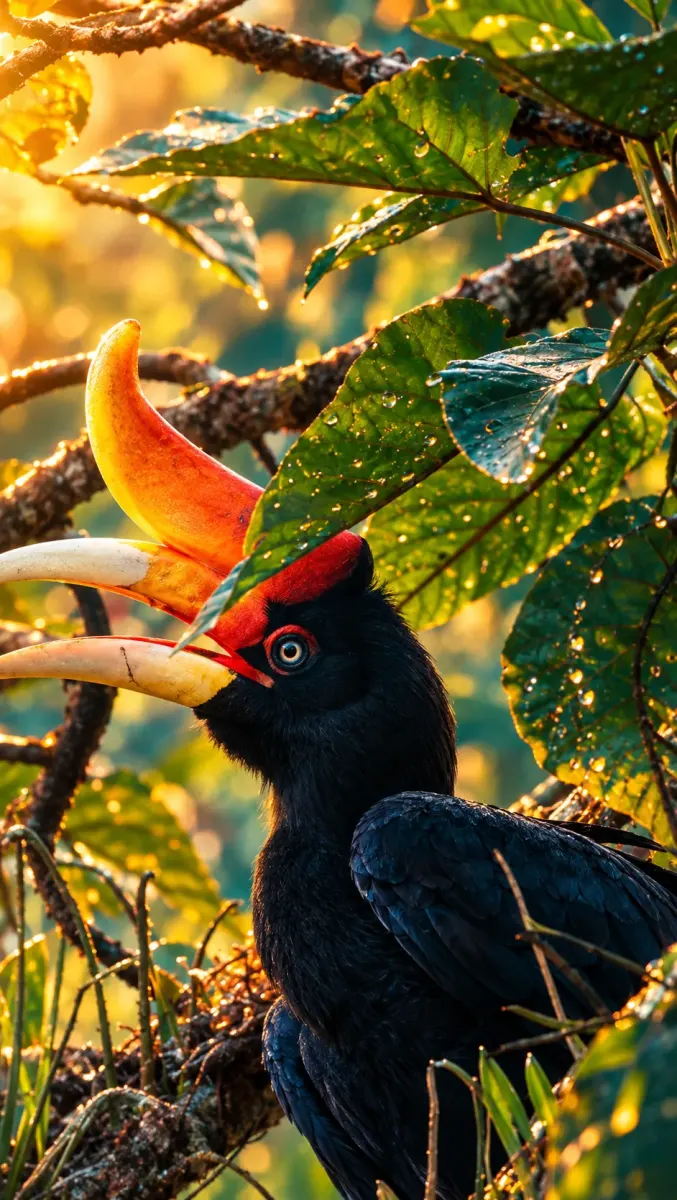
Field guide to Gunung Leuser wildlife in Bukit Lawang: Sumatran orangutans, Thomas Leaf monkeys, gibbons, siamangs, hornbills & nocturnal species.
While most travelers come to Bukit Lawang dreaming of their first eye-level encounter with a wild Sumatran orangutan (Pongo abelii), it takes less than thirty minutes inside Gunung Leuser National Park to realize that the orangutan is just one member of a vast, interconnected rainforest symphony. Spanning 7,927 square kilometers across the Barisan Mountain spine of North Sumatra and Aceh, this UNESCO Biosphere Reserve protects over 105 mammal species, 380 bird species, and 10,000 plant species.
Pair this written naturalist guide with our offline-ready Interactive Bukit Lawang Wildlife Spotter Tool to inspect high-resolution photographs, study acoustic call signatures, log species as you spot them on the trail, and generate a printable Rainforest Field Certificate.
1. How to Scan the Jungle: The 4 Vertical Layers of Gunung Leuser
In an equatorial dipterocarp rainforest, wildlife is stratified vertically by altitude above the ground. Knowing which layer of the forest to scan—and listening for acoustic clues before looking with your eyes—will dramatically increase what you see on the trail:
Hornbills, Eagles & Giant Dipterocarps
Towering Shorea and Koompassia trees rise above the main forest roof. Listen for the locomotive-like whooshing wingbeats and resonant “Rrok-rrok!” barks of Rhinoceros Hornbills and Crested Serpent Eagles scanning the valley.
Orangutans, Gibbons & Siamangs
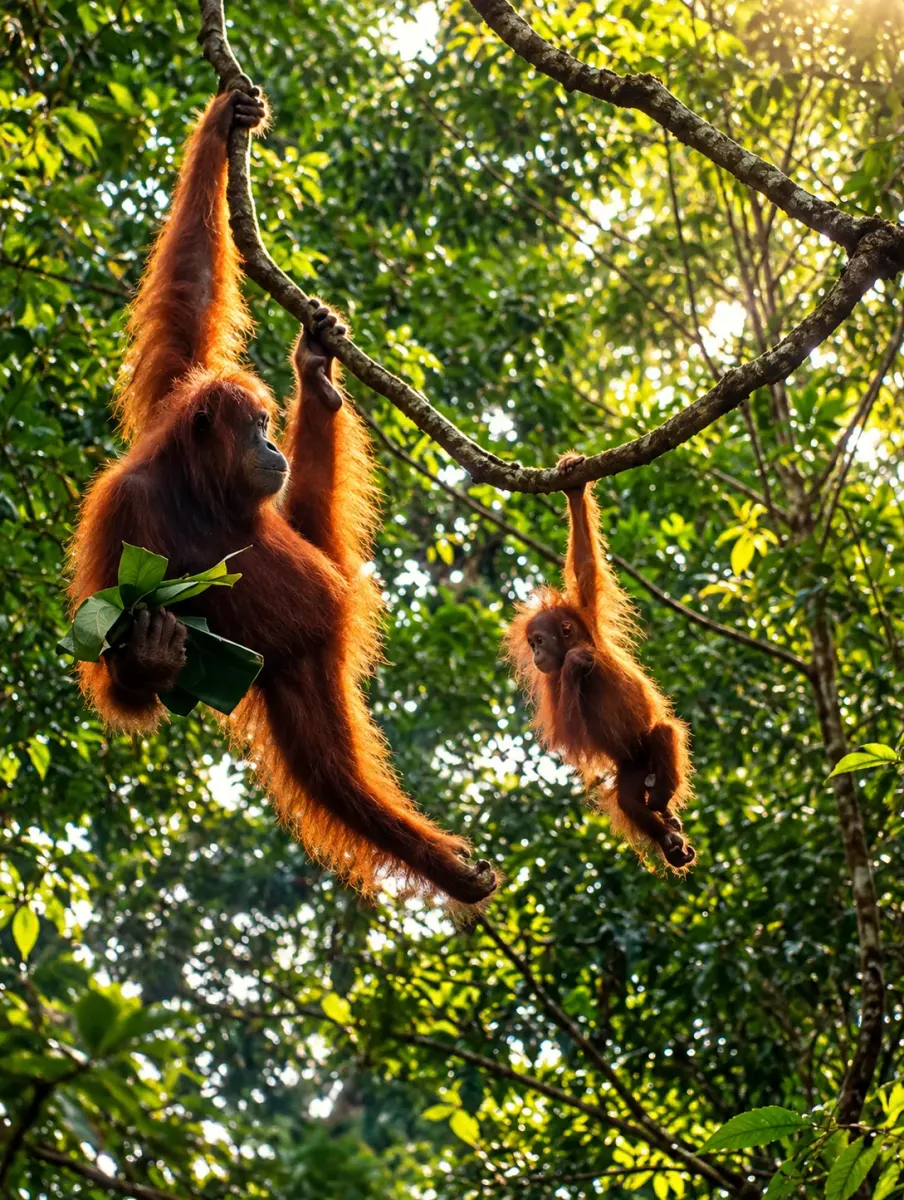
A dense highway of interlocking branches, liana vines, and fruiting strangler figs (Ficus). This is the exclusive realm of Sumatran Orangutans, brachiating White-Handed Gibbons, and booming black Siamangs.
Thomas Leaf Monkeys, Lorises & Pit Vipers
Shaded lower branches, wild nutmeg trees, and riverside bamboo thickets host endemic Thomas Leaf Monkeys (Kedih), Long-Tailed Macaques, nocturnal Greater Slow Lorises, and motionless Wagler’s Pit Vipers.
Pig-Tailed Macaques, Pheasants & Monitors
Root staircases, fallen logs, and Bohorok/Landak river boulders are patrolled by terrestrial troops of Pig-Tailed Macaques (Beruk), dancing Great Argus Pheasants, 1.8m Asian Water Monitor Lizards, and Giant Forest Ants.
2. Master Species Identification Table: 12 Iconic Animals of Bukit Lawang
Below is the verified field reference table for the twelve flagship species documented in our Bukit Lawang Wildlife Spotter. Remember that Gunung Leuser is a wild ecosystem—spotting rates reflect natural encounter probabilities with experienced HPI trackers, never commercial guarantees:
| Species & Scientific Name | Local Name | IUCN Status | Key Field Marks & Acoustic Signature |
|---|---|---|---|
|
Sumatran Orangutan Pongo abelii |
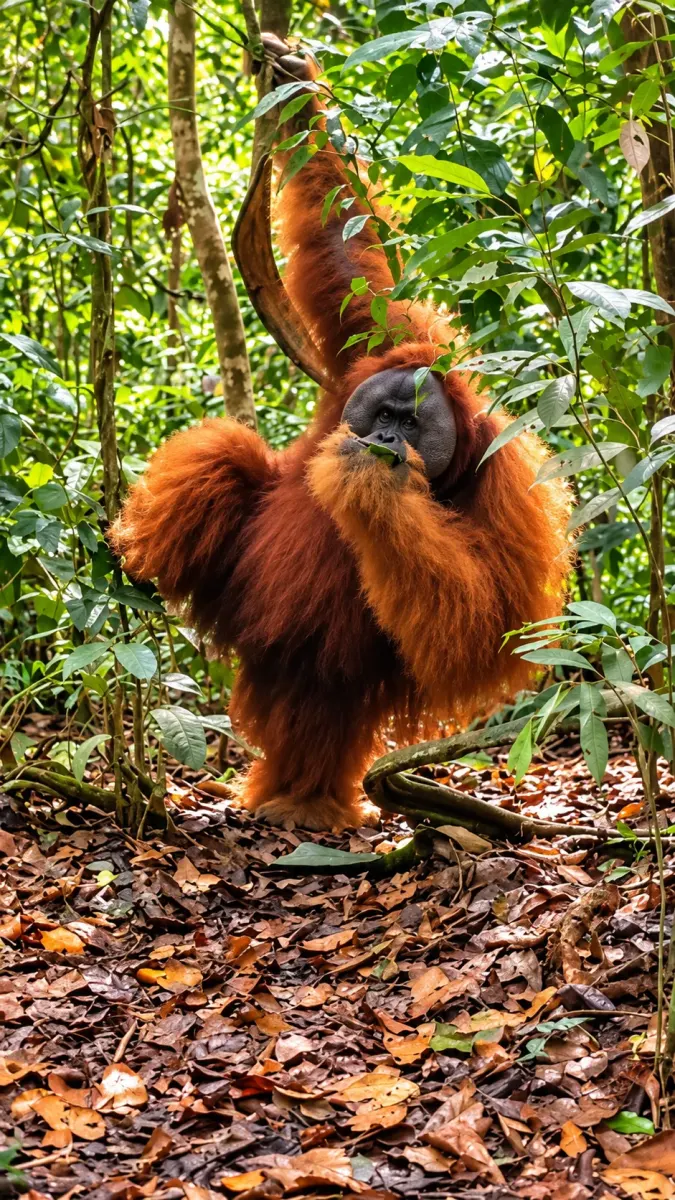
Mawas / Orangutan | Critically Endangered | Long ginger-cinnamon coat, white beard, flanged cheek pads on alpha males; booming Long Call & kiss-squeak. |
|
Thomas Leaf Monkey Presbytis thomasi |
Monyet Kedih | Vulnerable (Endemic) | Distinctive "punk-rock" mohawk crest, white belly & eye rings; rapid “chug-chug-chew!” morning alarm chatter. |
|
White-Handed Gibbon Hylobates lar |
Owa Serudung | Endangered | Creamy-white hands, feet & face ring; high-speed brachiation; soaring “whoo-oo-wheet!” sunrise duet. |
|
Siamang (Giant Black Gibbon) Symphalangus syndactylus |
Siamang | Endangered | Largest gibbon on Earth (1.5m arm span), jet-black fur, inflatable throat sac echoing up to 3 km across valleys. |
|
Pig-Tailed Macaque Macaca nemestrina |
Beruk | Endangered | Muscular olive-brown build, short pig-like curled tail; travels in large ground troops along riverbanks. |
|
Greater Slow Loris Nycticebus coucang |
Kukang / Malu-Malu | Endangered (Nocturnal) | Large reflective amber eyes, dorsal dark stripe, slow deliberate climbing; world’s only venomous primate. |
|
Rhinoceros Hornbill Buceros rhinoceros |
Burung Rangkong | Vulnerable | Upward-curving orange-red casque, white tail with black band; loud steam-train wingbeats & “rrok!” calls. |
|
Great Argus Pheasant Argusianus argus |
Burung Kuau Raja | Vulnerable | Elaborate eye-spotted wing plumage, cleared 4m forest floor dancing rings; echoing “Ku-waaaw!” cry. |
|
Red Giant Flying Squirrel Petaurista petaurista |
Tupai Terbang | Least Concern | Mahogany-red fur, patagium gliding membrane; launches from 40m trees across rivers at twilight (18:15–18:45). |
|
Malayan Sun Bear Helarctos malayanus |
Beruang Madu | Vulnerable | Smallest bear species, golden chest crescent; deep vertical claw marks frequently seen on wild bee trees. |
|
Asian Water Monitor Varanus salvator |
Biawak Air | Least Concern | Up to 1.8m semi-aquatic lizard with yellow-ringed dark scales; sunbathes on warm Bohorok & Landak boulders. |
|
Wagler’s Pit Viper Tropidolaemus wagleri |
Ular Bangkai Laut | Least Concern | Triangular head, emerald-green & yellow bands; rests motionless on low streamside branches (1–2m high). |
3. Spotlight on Bukit Lawang’s Primate Guild: Apes vs Monkeys
Many visitors are surprised to learn how easily you can distinguish Gunung Leuser’s primates in the field. The fastest anatomical clue is simple: apes do not have tails, whereas all monkeys have tails.
- The Great Ape — Sumatran Orangutan (Pongo abelii): Strictly arboreal, deliberate climbers with long cinnamon-orange hair. Unlike Bornean orangutans, Sumatran orangutans form looser social clusters around giant fruiting fig trees and use leafy twigs as tools to extract stinging insects or Neesia seeds. Read our dedicated biology guide on Sumatran vs Bornean Orangutan: 7 Biological Differences.
- The Lesser Apes — White-Handed Gibbon & Siamang: True acrobats of the upper canopy (30m–45m high) that swing hand-over-hand (brachiation) at speeds up to 55 km/h. Monogamous pairs defend their forest territories every morning between 06:30 and 08:30 WIB with complex vocal duets—explore The Acoustic Canopy: Gibbons & Siamangs of Gunung Leuser.
- The Endemic Leaf Monkey — Thomas Leaf Monkey (Kedih): Found nowhere on Earth outside northern Sumatra (north of the Wampu and Simpang Kiri rivers). Their black-and-white facial markings, punk-rock hair crest, and creamy-white newborn infants make them a favorite subject for wildlife photographers—read our Thomas Leaf Monkey (Kedih) Field Guide.
- The Forest Floor Foragers — Long-Tailed & Pig-Tailed Macaques: Highly adaptable omnivores with cheek pouches for storing fruit. Keep all food sealed inside your backpack (as detailed in our Gunung Leuser Packing Guide) so macaques never associate trekkers with snacks.
4. Where Are the Tigers, Elephants & Rhinos?
Gunung Leuser is globally celebrated as the last sanctuary where orangutans coexist with Sumatran Tigers (Panthera tigris sondaica), Sumatran Elephants (Elephas maximus sumatranus), and Sumatran Rhinos (Dicerorhinus sumatrensis). A common question from cautious first-time trekkers is: “Will we run into a tiger or wild elephant on the Bukit Lawang trails?”
On 1-day to 3-day treks around the Bukit Lawang buffer zone, the answer is no. Elusive megafauna actively avoid human trail corridors and remain deep inside the remote interior valleys, montane core zones, and the Bekail/Aras Napal watersheds (accessible only on 4-Day to 7-Day Deep Wilderness Expeditions). If you wish to observe Sumatran elephants ethically, you can combine your Bukit Lawang trek with a 2.5-hour overland transfer to the Conservation Response Unit (CRU) at Tangkahan—see our Bukit Lawang to Tangkahan Transfer Guide and Sumatran Megafauna Coexistence Guide.
5. How to Maximize Your Ethical Wildlife Spotting Rate
To experience the fullest spectrum of Gunung Leuser’s diurnal, crepuscular (dusk/dawn), and nocturnal biodiversity while strictly honoring our 7 Mandatory Ethical Wildlife Observation Rules:
- Stay Overnight in the Jungle (2D1N or 3D2N): Booking the 2D1N Overnight Jungle Camp (€120 / person) or 3D2N Deep Wilderness Expedition (€170 / person) places you beside the upper Bohorok or Landak River during the peak wildlife activity windows of 16:30–18:30 WIB and 06:00–08:30 WIB.
- Add a Guided Jungle Night Walk (€25 / person): After sunset, a completely different shift of rainforest life awakens: Greater Slow Lorises, civet cats, sleeping forest kingfishers, giant huntsman spiders, horned frogs, and glowing bioluminescent fungi (Mycena). Read more in Bukit Lawang After Dark: Slow Lorises & Bioluminescent Fungi.
- Bring 8x42 Binoculars or a 200mm+ Zoom Lens: Because ethical rules mandate a minimum 10-meter distance from orangutans—and gibbons/hornbills perch 30–50 meters high—compact roof-prism binoculars reveal extraordinary facial details without disturbing the canopy.
Log Your Gunung Leuser Wildlife Sightings & Earn Your Certificate
Open our interactive Wildlife Spotter to filter species by primates, birds, nocturnal mammals, and rare flora (Rafflesia & Titan Arum), check off animals you encounter on your trek, and download a personalized A4 Field Naturalist Certificate.