Trail & River Advisory
Sumatran vs Bornean Orangutan: 7 Biological Differences
Click to enlarge

The word orangutan comes from the Malay and Indonesian words orang ("person") and hutan ("forest")—literally translating to the "Person of the Forest." Today, wild orangutans survive on only two islands on Earth: Sumatra and Borneo. Yet if you compare a wild orangutan swinging high through the dipterocarp ridges of Bukit Lawang (Gunung Leuser National Park) with an orangutan in Kalimantan or Malaysian Borneo, you are actually looking at two completely different biological species separated by over a million years of evolution.

Whether you are a wildlife enthusiast fascinated by great ape evolution or a traveler deciding between a rainforest expedition in North Sumatra vs. Borneo, this field guide breaks down the 7 biological, morphological, and behavioral differences between the Sumatran Orangutan (Pongo abelii) and the Bornean Orangutan (Pongo pygmaeus)—plus how to log your sightings on our Interactive Gunung Leuser Wildlife Spotter Checklist.

1.Coat Color, Hair Texture & Facial Beard

When you spot your first wild Sumatran Orangutan (Pongo abelii) in the morning sunlight of Gunung Leuser, the visual difference from its Bornean cousin is striking:

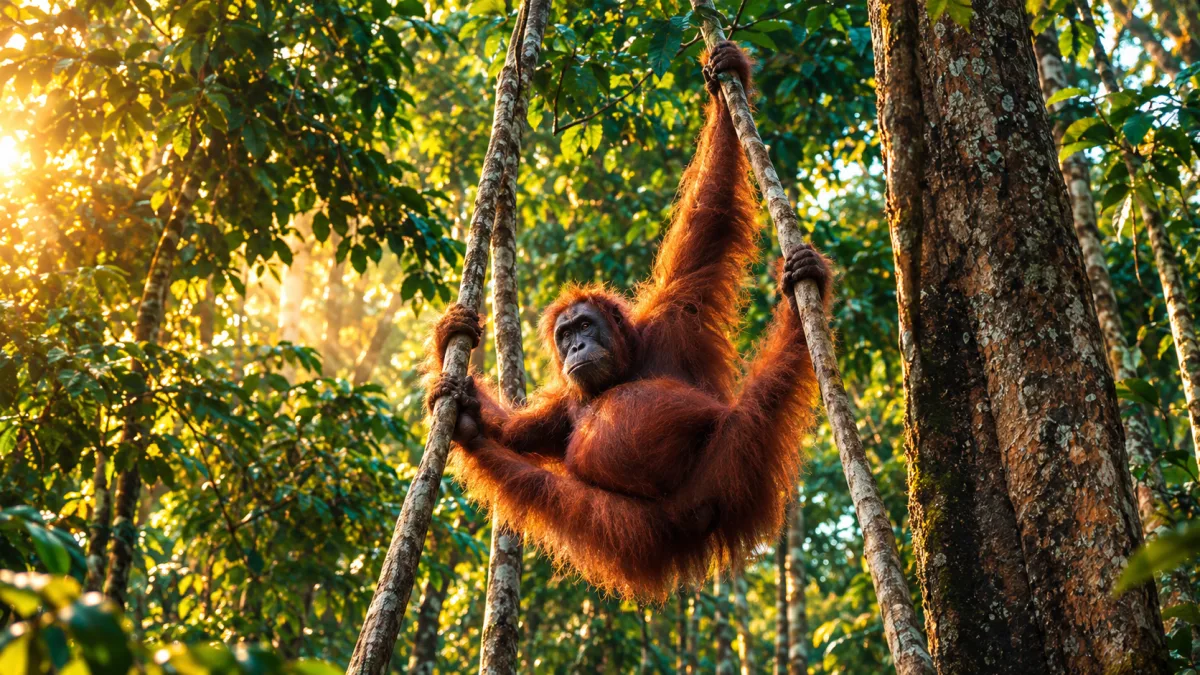
  • Sumatran Orangutan (Pongo abelii): Possesses a significantly longer, denser, and fleecier coat that glows a bright cinnamon-orange or fiery ginger in canopy light. Their faces are more oval and elongated, and both adult males and females grow a distinctive long, pale blonde-white beard and mustache around the chin.
  • Bornean Orangutan (Pongo pygmaeus): Has darker, coarser, and sparser hair ranging from deep mahogany-red to dark maroon-brown, paired with a broader face and minimal facial beard hair.

2. Dominant Male Cheek Pads (Flanges)

Adult male orangutans exhibit bimaturism—some mature into massive dominant males with prominent facial cheek pads (flanged males, locally revered by Bukit Lawang guides as "Big Bosses") and an inflatable throat sac used to broadcast booming 1.5-kilometer "long calls." However, the shape of those cheek pads differs sharply by island:

  • In Sumatra (Pongo abelii): The cheek pads lie flat and wide against the sides of the face, covered in fine white downy hair, creating a wide diamond-shaped or oval facial disc.
  • In Borneo (Pongo pygmaeus): The cheek pads are thicker, darker, and curve forward on either side of the nose like giant blinkers, giving dominant Bornean males a square, deeply hooded profile.

3. Strictly Arboreal Canopy Life vs. Walking on the Ground (The Sumatran Tiger Factor!)

One of the most fascinating behavioral differences between the two species comes down to a single apex predator:

  • Why Sumatran Orangutans Never Walk on the Forest Floor: In Gunung Leuser National Park, wild Sumatran orangutans spend more than 98% of their entire lives 20 to 40 meters up in the forest canopy—eating, traveling by branch-swaying, mating, and weaving a fresh leafy night nest every evening. Why do they almost never touch the ground? Because Sumatra’s rainforest floor is patrolled by the Sumatran Tiger (Panthera tigris sondaica) and the Sunda Clouded Leopard (Neofelis diardi). Over hundreds of thousands of years, predation pressure selected for strictly arboreal behavior in Pongo abelii.
  • Why Bornean Males Walk on the Ground: The island of Borneo has no tigers. Freed from large terrestrial predators, heavy adult male Bornean orangutans (80–100 kg) frequently climb down to walk long distances across the forest floor between fruit trees.

4. Volcanic Fruit Abundance & Dietary Adaptation

North Sumatra’s Barisan Mountain range sits along an active volcanic arc (including the ancient supervolcano caldera of Lake Toba). Rich volcanic mineral soils make the lowland rainforests of Gunung Leuser extraordinarily productive year-round, supporting massive densities of strangler figs (Ficus), wild forest durians (Durio), jackfruit, and wild rambutans (check our 12-Month Fruit Ripening Calendar).

In contrast, Borneo’s ancient weathered soils and peat swamps experience severe multi-year El Niño mast-fruiting droughts. When fruit disappears in Borneo, Pongo pygmaeus must rely on exceptionally powerful jaws to strip and chew tough inner tree bark (cambium) and fibrous pith. Thanks to Leuser’s year-round fig abundance, Sumatran orangutans enjoy a higher-calorie frugivorous & insectivorous diet.

5. Advanced Tool Manufacture & Cultural Intelligence

While all orangutans are remarkably intelligent—sharing roughly 97% of their DNA with humans—field primatologists studying wild Pongo abelii in the Leuser Ecosystem documented something extraordinary: systematic tool manufacture and cultural transmission:

  • Insect & Honey Probing Sticks: Wild Sumatran orangutans select straight woody twigs, strip off the outer bark, fray the tip with their teeth into a brush, and hold the tool in their mouth or fingers to extract stingless bees’ honey and termites from deep tree-trunk crevices.
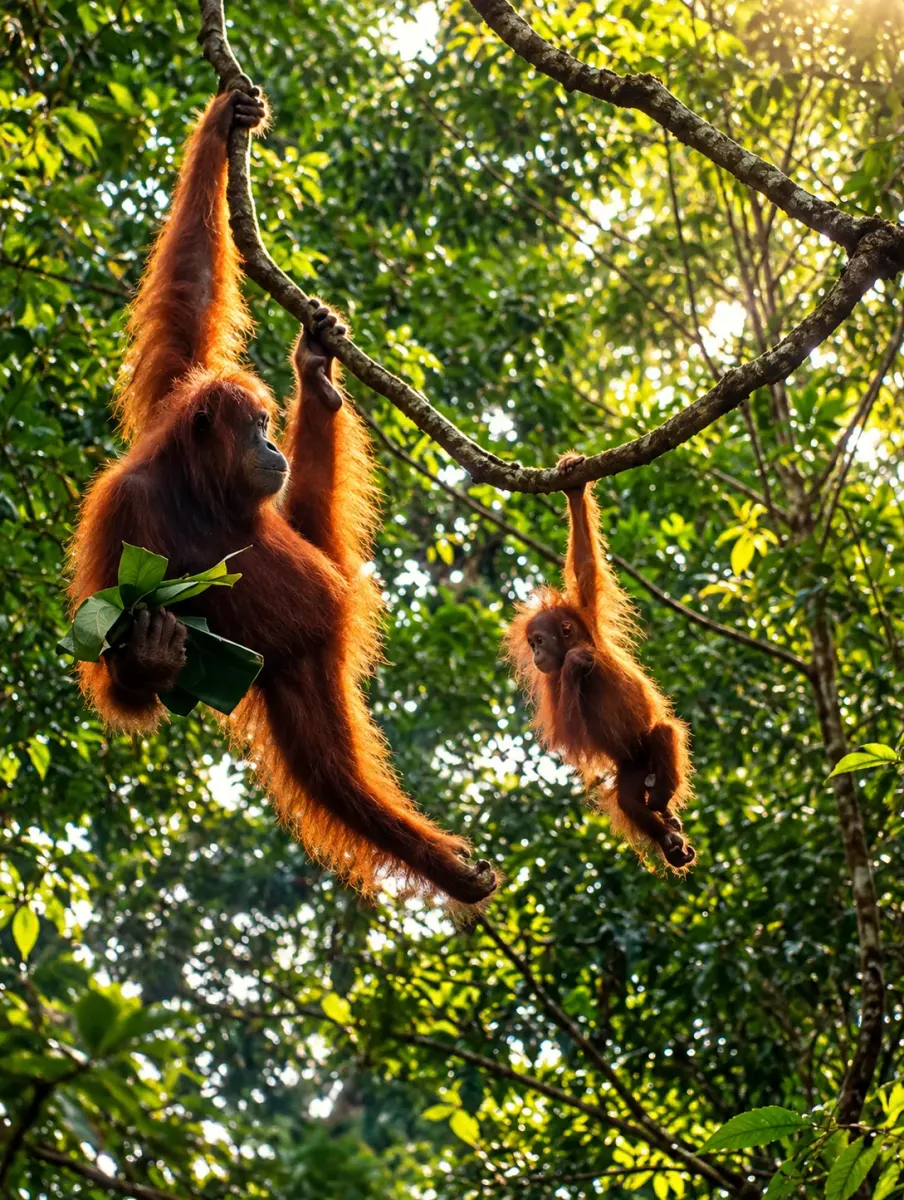
  • Spiny Fruit "Gloves" & Umbrellas: To pry open the razor-sharp woody husks of nutritious Neesia and wild durian fruits without pricking their fingers, Sumatran orangutans use stripped sticks as wedges and wad up large tough leaves to use as protective hand-gloves—behaviors passed down from mothers to infants across generations!

6. Higher Social Tolerance in the Canopy

Adult orangutans are famous for being the most solitary of the great apes (unlike chimpanzees, gorillas, or bonobos, which live in permanent troops). However, because Gunung Leuser’s giant strangler fig trees produce enormous simultaneous fruit crops, Sumatran orangutans are noticeably more socially tolerant than Bornean orangutans. During Bukit Lawang’s December–February fruit season, HPI guides occasionally observe two or three adult females, sub-adults, and playful juveniles feeding peacefully within the same sprawling canopy crown.

7. The 8-to-9-Year Mother-Infant Bond (Longest of Any Land Mammal)

A Sumatran orangutan mother gives birth only once every 8 to 9 years—the longest interbirth interval of any land mammal on Earth (compared to roughly 6 to 8 years in Bornean orangutans). For the first two years, the infant clings continuously to its mother’s ginger fur; for another five to six years, the juvenile travels beside her, learning the spatial map of thousands of fruiting trees and how to weave secure rain-roof nests. Because a female may raise only 3 or 4 surviving offspring in her entire 45-year lifespan, protecting every single wild female from human pathogens and stress is essential to saving the species.

8. Complete Scientific Matrix: Sumatran vs. Bornean vs. Tapanuli Orangutan

Did you know that North Sumatra is actually home to two of the world’s three orangutan species? In 2017, scientists confirmed that an isolated upland population living in the Batang Toru forest south of Lake Toba represents a third distinct species: the Tapanuli Orangutan (Pongo tapanuliensis). Compare all three species below:

Biological Trait Sumatran Orangutan
(Pongo abelii)
Bornean Orangutan
(Pongo pygmaeus)
Tapanuli Orangutan
(Pongo tapanuliensis)
Natural Habitat Northern Sumatra (Gunung Leuser Ecosystem / Bukit Lawang & Aceh) Island of Borneo (Kalimantan, Sabah & Sarawak) Batang Toru Uplands (South of Lake Toba, North Sumatra)
IUCN Red List Status Critically Endangered (CR) (~13,800 wild individuals) Critically Endangered (CR) (~55,000–100,000 individuals) Critically Endangered (CR) (~800 wild individuals — rarest great ape)
Hair Color & Texture Long, dense, silky bright cinnamon-orange / ginger; long blonde beard. Coarser, sparser dark reddish-brown / maroon; minimal beard. Thick, frizzy cinnamon fur; prominent mustaches on males.
Male Cheek Pads (Flanges) Flat, wide diamond-shaped flanges covered in fine white fuzz. Large, thick, forward-curving dark flanges around the face. Flat, wide flanges similar to P. abelii but broader skull shape.
Canopy vs. Ground Behavior >98% Strictly Arboreal (avoids Sumatran tigers on forest floor). Arboreal, but adult males frequently walk on the ground (no tigers). Strictly arboreal in steep upland sub-montane hills.
Interbirth Interval 8 – 9 Years (longest on Earth) 6 – 8 Years 8 – 9 Years

9. Trekking in Bukit Lawang (Sumatra) vs. Borneo: Which Should You Choose?

From a traveler’s perspective, observing orangutans in Borneo (such as Tanjung Puting in Central Kalimantan or Sepilok/Kinabatangan in Sabah) feels completely different from trekking in Bukit Lawang, North Sumatra:

  • The Borneo Experience (Riverboats & Boardwalks): Much of Borneo’s accessible orangutan habitat consists of flat lowland peat-swamp forest. Visitors primarily travel by wooden river houseboats (klotok) or walk along elevated wooden boardwalks to scheduled feeding platforms.
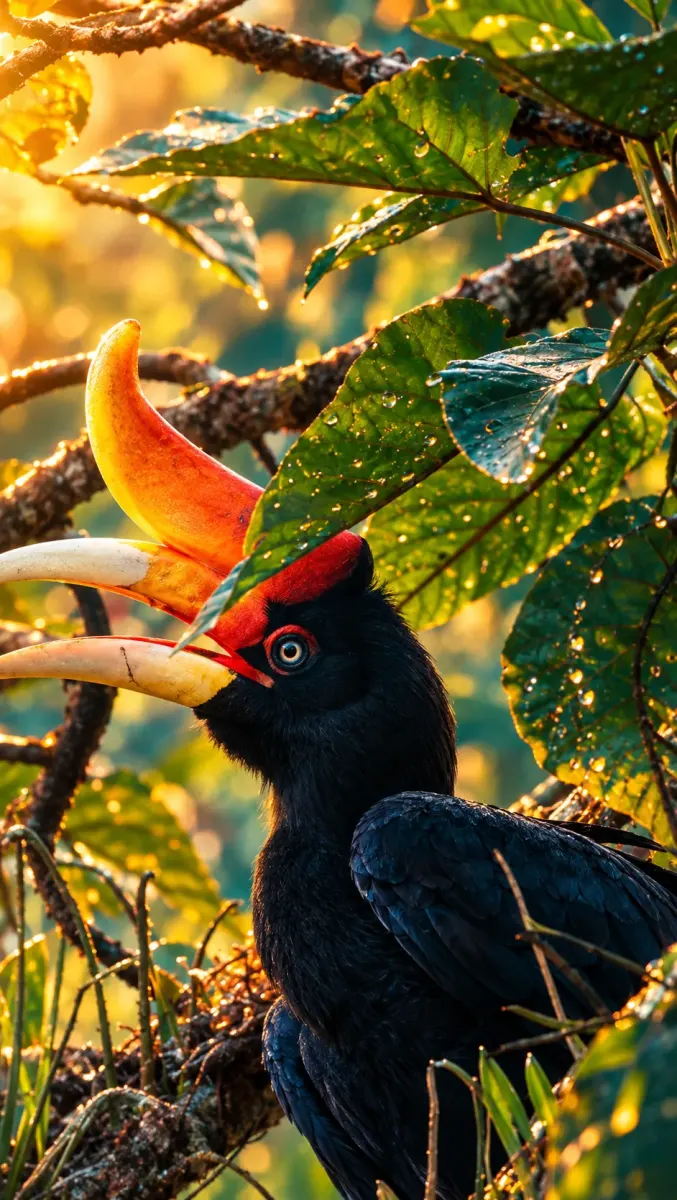
  • The Bukit Lawang / Gunung Leuser Experience (True Mountain Jungle Trekking): In Bukit Lawang, there are no active feeding platforms (the historic Bohorok rehabilitation feeding site closed permanently over a decade ago to protect wild health) and no boardwalks. You hike on foot with HPI member guides up steep, root-laddered mountain ridges (115m–580m ASL), tracking wild orangutans alongside endemic Thomas's Leaf Monkeys, White-Handed Gibbons, Siamangs, and Rhinoceros Hornbills—before sleeping at a riverside bamboo camp and riding a River Tube Raft ("Jungle Taxi") down the Bohorok rapids!

10. Compare Ethical Sumatran Orangutan Trekking Packages

Ready to observe Pongo abelii ethically in its high-canopy home? Compare our all-inclusive Gunung Leuser expeditions below:

€
Guide rates in this article are displayed in: EUR (€) Automatically converted from standard HPI Langkat reference tariffs (Base: EUR).
Switch currency in top header
Gunung Leuser Expedition Primary Primate & Canopy Focus Standard Rate (EUR) Approx. Benchmark (IDR)
3-Hour Jungle Discovery Lower canopy ridges: semi-wild orangutans & Thomas Leaf Monkeys €55 / person €110 private (2-person min.)
1-Day Orangutan Discovery + Tubing Primary & secondary ridges + banana-leaf lunch + river tubing €70 / person €140 private (2-person min.)
2D1N Jungle Camp + River Tubing Deep Landak valley + overnight camp + gibbon dawn chorus €120 / person €240 private (2-person min.)
3D2N Deep Wilderness Expedition Unhabituated primary ridges + Siamangs + Jamur Batu camp €170 / person €340 private (2-person min.)
4D3N Remote Canopy Crossing Deep primary Leuser ecosystem + 3 remote riverside camps €250 / person €500 private (2-person min.)

Explore Our Interactive Gunung Leuser Wildlife Spotter

Inspect all 12 iconic Gunung Leuser species with IUCN conservation status, acoustic call descriptions, and HPI tracker tips, or compare our ethical trekking packages.
Share This Guide With Your Travel Partner Planning a Sumatra expedition together?
WhatsApp Facebook X Telegram Email
Explore Bukit Lawang Team
Verified Guide & Author • 15+ Years in Leuser

Explore Bukit Lawang Team

HPI Member Guides, Wildlife Naturalists & Conservation Collective

The editorial and expedition team of Explore Bukit Lawang — local HPI member guides, primate trackers, river captains and conservation educators born along the Bohorok River.

Experience Gunung Leuser In Person

Ready to Trek with Our Local HPI Guides?

National park permits, small private groups, and traditional river tubing included on every expedition.

Wildlife & Nature • 10 min read • 28 views • November 09, 2026
Sumatran vs Bornean Orangutan: 7 Biological Differences

Compare Sumatran (Pongo abelii) vs Bornean (Pongo pygmaeus) orangutans: 7 key differences in coat color, canopy behavior, tool use & Bukit Lawang trekking.

Explore Bukit Lawang Team
Explore Bukit Lawang Team HPI Member Guides, Wildlife Naturalists & Conservation Collective

The word orangutan comes from the Malay and Indonesian words orang ("person") and hutan ("forest")—literally translating to the "Person of the Forest." Today, wild orangutans survive on only two islands on Earth: Sumatra and Borneo. Yet if you compare a wild orangutan swinging high through the dipterocarp ridges of Bukit Lawang (Gunung Leuser National Park) with an orangutan in Kalimantan or Malaysian Borneo, you are actually looking at two completely different biological species separated by over a million years of evolution.

Whether you are a wildlife enthusiast fascinated by great ape evolution or a traveler deciding between a rainforest expedition in North Sumatra vs. Borneo, this field guide breaks down the 7 biological, morphological, and behavioral differences between the Sumatran Orangutan (Pongo abelii) and the Bornean Orangutan (Pongo pygmaeus)—plus how to log your sightings on our Interactive Gunung Leuser Wildlife Spotter Checklist.

1.Coat Color, Hair Texture & Facial Beard

When you spot your first wild Sumatran Orangutan (Pongo abelii) in the morning sunlight of Gunung Leuser, the visual difference from its Bornean cousin is striking:

  • Sumatran Orangutan (Pongo abelii): Possesses a significantly longer, denser, and fleecier coat that glows a bright cinnamon-orange or fiery ginger in canopy light. Their faces are more oval and elongated, and both adult males and females grow a distinctive long, pale blonde-white beard and mustache around the chin.
  • Bornean Orangutan (Pongo pygmaeus): Has darker, coarser, and sparser hair ranging from deep mahogany-red to dark maroon-brown, paired with a broader face and minimal facial beard hair.

2. Dominant Male Cheek Pads (Flanges)

Adult male orangutans exhibit bimaturism—some mature into massive dominant males with prominent facial cheek pads (flanged males, locally revered by Bukit Lawang guides as "Big Bosses") and an inflatable throat sac used to broadcast booming 1.5-kilometer "long calls." However, the shape of those cheek pads differs sharply by island:

  • In Sumatra (Pongo abelii): The cheek pads lie flat and wide against the sides of the face, covered in fine white downy hair, creating a wide diamond-shaped or oval facial disc.
  • In Borneo (Pongo pygmaeus): The cheek pads are thicker, darker, and curve forward on either side of the nose like giant blinkers, giving dominant Bornean males a square, deeply hooded profile.

3. Strictly Arboreal Canopy Life vs. Walking on the Ground (The Sumatran Tiger Factor!)

One of the most fascinating behavioral differences between the two species comes down to a single apex predator:

  • Why Sumatran Orangutans Never Walk on the Forest Floor: In Gunung Leuser National Park, wild Sumatran orangutans spend more than 98% of their entire lives 20 to 40 meters up in the forest canopy—eating, traveling by branch-swaying, mating, and weaving a fresh leafy night nest every evening. Why do they almost never touch the ground? Because Sumatra’s rainforest floor is patrolled by the Sumatran Tiger (Panthera tigris sondaica) and the Sunda Clouded Leopard (Neofelis diardi). Over hundreds of thousands of years, predation pressure selected for strictly arboreal behavior in Pongo abelii.
  • Why Bornean Males Walk on the Ground: The island of Borneo has no tigers. Freed from large terrestrial predators, heavy adult male Bornean orangutans (80–100 kg) frequently climb down to walk long distances across the forest floor between fruit trees.

4. Volcanic Fruit Abundance & Dietary Adaptation

North Sumatra’s Barisan Mountain range sits along an active volcanic arc (including the ancient supervolcano caldera of Lake Toba). Rich volcanic mineral soils make the lowland rainforests of Gunung Leuser extraordinarily productive year-round, supporting massive densities of strangler figs (Ficus), wild forest durians (Durio), jackfruit, and wild rambutans (check our 12-Month Fruit Ripening Calendar).

In contrast, Borneo’s ancient weathered soils and peat swamps experience severe multi-year El Niño mast-fruiting droughts. When fruit disappears in Borneo, Pongo pygmaeus must rely on exceptionally powerful jaws to strip and chew tough inner tree bark (cambium) and fibrous pith. Thanks to Leuser’s year-round fig abundance, Sumatran orangutans enjoy a higher-calorie frugivorous & insectivorous diet.

5. Advanced Tool Manufacture & Cultural Intelligence

While all orangutans are remarkably intelligent—sharing roughly 97% of their DNA with humans—field primatologists studying wild Pongo abelii in the Leuser Ecosystem documented something extraordinary: systematic tool manufacture and cultural transmission:

  • Insect & Honey Probing Sticks: Wild Sumatran orangutans select straight woody twigs, strip off the outer bark, fray the tip with their teeth into a brush, and hold the tool in their mouth or fingers to extract stingless bees’ honey and termites from deep tree-trunk crevices.
  • Spiny Fruit "Gloves" & Umbrellas: To pry open the razor-sharp woody husks of nutritious Neesia and wild durian fruits without pricking their fingers, Sumatran orangutans use stripped sticks as wedges and wad up large tough leaves to use as protective hand-gloves—behaviors passed down from mothers to infants across generations!

6. Higher Social Tolerance in the Canopy

Adult orangutans are famous for being the most solitary of the great apes (unlike chimpanzees, gorillas, or bonobos, which live in permanent troops). However, because Gunung Leuser’s giant strangler fig trees produce enormous simultaneous fruit crops, Sumatran orangutans are noticeably more socially tolerant than Bornean orangutans. During Bukit Lawang’s December–February fruit season, HPI guides occasionally observe two or three adult females, sub-adults, and playful juveniles feeding peacefully within the same sprawling canopy crown.

7. The 8-to-9-Year Mother-Infant Bond (Longest of Any Land Mammal)

A Sumatran orangutan mother gives birth only once every 8 to 9 years—the longest interbirth interval of any land mammal on Earth (compared to roughly 6 to 8 years in Bornean orangutans). For the first two years, the infant clings continuously to its mother’s ginger fur; for another five to six years, the juvenile travels beside her, learning the spatial map of thousands of fruiting trees and how to weave secure rain-roof nests. Because a female may raise only 3 or 4 surviving offspring in her entire 45-year lifespan, protecting every single wild female from human pathogens and stress is essential to saving the species.

8. Complete Scientific Matrix: Sumatran vs. Bornean vs. Tapanuli Orangutan

Did you know that North Sumatra is actually home to two of the world’s three orangutan species? In 2017, scientists confirmed that an isolated upland population living in the Batang Toru forest south of Lake Toba represents a third distinct species: the Tapanuli Orangutan (Pongo tapanuliensis). Compare all three species below:

Biological Trait Sumatran Orangutan
(Pongo abelii)
Bornean Orangutan
(Pongo pygmaeus)
Tapanuli Orangutan
(Pongo tapanuliensis)
Natural Habitat Northern Sumatra (Gunung Leuser Ecosystem / Bukit Lawang & Aceh) Island of Borneo (Kalimantan, Sabah & Sarawak) Batang Toru Uplands (South of Lake Toba, North Sumatra)
IUCN Red List Status Critically Endangered (CR) (~13,800 wild individuals) Critically Endangered (CR) (~55,000–100,000 individuals) Critically Endangered (CR) (~800 wild individuals — rarest great ape)
Hair Color & Texture Long, dense, silky bright cinnamon-orange / ginger; long blonde beard. Coarser, sparser dark reddish-brown / maroon; minimal beard. Thick, frizzy cinnamon fur; prominent mustaches on males.
Male Cheek Pads (Flanges) Flat, wide diamond-shaped flanges covered in fine white fuzz. Large, thick, forward-curving dark flanges around the face. Flat, wide flanges similar to P. abelii but broader skull shape.
Canopy vs. Ground Behavior >98% Strictly Arboreal (avoids Sumatran tigers on forest floor). Arboreal, but adult males frequently walk on the ground (no tigers). Strictly arboreal in steep upland sub-montane hills.
Interbirth Interval 8 – 9 Years (longest on Earth) 6 – 8 Years 8 – 9 Years

9. Trekking in Bukit Lawang (Sumatra) vs. Borneo: Which Should You Choose?

From a traveler’s perspective, observing orangutans in Borneo (such as Tanjung Puting in Central Kalimantan or Sepilok/Kinabatangan in Sabah) feels completely different from trekking in Bukit Lawang, North Sumatra:

  • The Borneo Experience (Riverboats & Boardwalks): Much of Borneo’s accessible orangutan habitat consists of flat lowland peat-swamp forest. Visitors primarily travel by wooden river houseboats (klotok) or walk along elevated wooden boardwalks to scheduled feeding platforms.
  • The Bukit Lawang / Gunung Leuser Experience (True Mountain Jungle Trekking): In Bukit Lawang, there are no active feeding platforms (the historic Bohorok rehabilitation feeding site closed permanently over a decade ago to protect wild health) and no boardwalks. You hike on foot with HPI member guides up steep, root-laddered mountain ridges (115m–580m ASL), tracking wild orangutans alongside endemic Thomas's Leaf Monkeys, White-Handed Gibbons, Siamangs, and Rhinoceros Hornbills—before sleeping at a riverside bamboo camp and riding a River Tube Raft ("Jungle Taxi") down the Bohorok rapids!

10. Compare Ethical Sumatran Orangutan Trekking Packages

Ready to observe Pongo abelii ethically in its high-canopy home? Compare our all-inclusive Gunung Leuser expeditions below:

€
Guide rates in this article are displayed in: EUR (€) Automatically converted from standard HPI Langkat reference tariffs (Base: EUR).
Switch currency in top header
Gunung Leuser Expedition Primary Primate & Canopy Focus Standard Rate (EUR) Approx. Benchmark (IDR)
3-Hour Jungle Discovery Lower canopy ridges: semi-wild orangutans & Thomas Leaf Monkeys €55 / person €110 private (2-person min.)
1-Day Orangutan Discovery + Tubing Primary & secondary ridges + banana-leaf lunch + river tubing €70 / person €140 private (2-person min.)
2D1N Jungle Camp + River Tubing Deep Landak valley + overnight camp + gibbon dawn chorus €120 / person €240 private (2-person min.)
3D2N Deep Wilderness Expedition Unhabituated primary ridges + Siamangs + Jamur Batu camp €170 / person €340 private (2-person min.)
4D3N Remote Canopy Crossing Deep primary Leuser ecosystem + 3 remote riverside camps €250 / person €500 private (2-person min.)

Explore Our Interactive Gunung Leuser Wildlife Spotter

Inspect all 12 iconic Gunung Leuser species with IUCN conservation status, acoustic call descriptions, and HPI tracker tips, or compare our ethical trekking packages.
You have reached the end of this field dispatch

Written by local HPI member guides from Bukit Lawang. If you have questions about packing, permits, or trail conditions, reach out anytime.

Chat with Guide on WhatsApp

Park Permit Assistance

Facilitated at Balai Besar TNGL checkpoints

Ethical Jungle Trekking

Zero feeding & 10m distance policy

Traditional River Tubing

Safety gear & skilled river captains

Works Fully Offline

Guides work deep inside rainforest