Trail & River Advisory
Thomas Leaf Monkey (Kedih): North Sumatra Endemic Primate
Click to enlarge

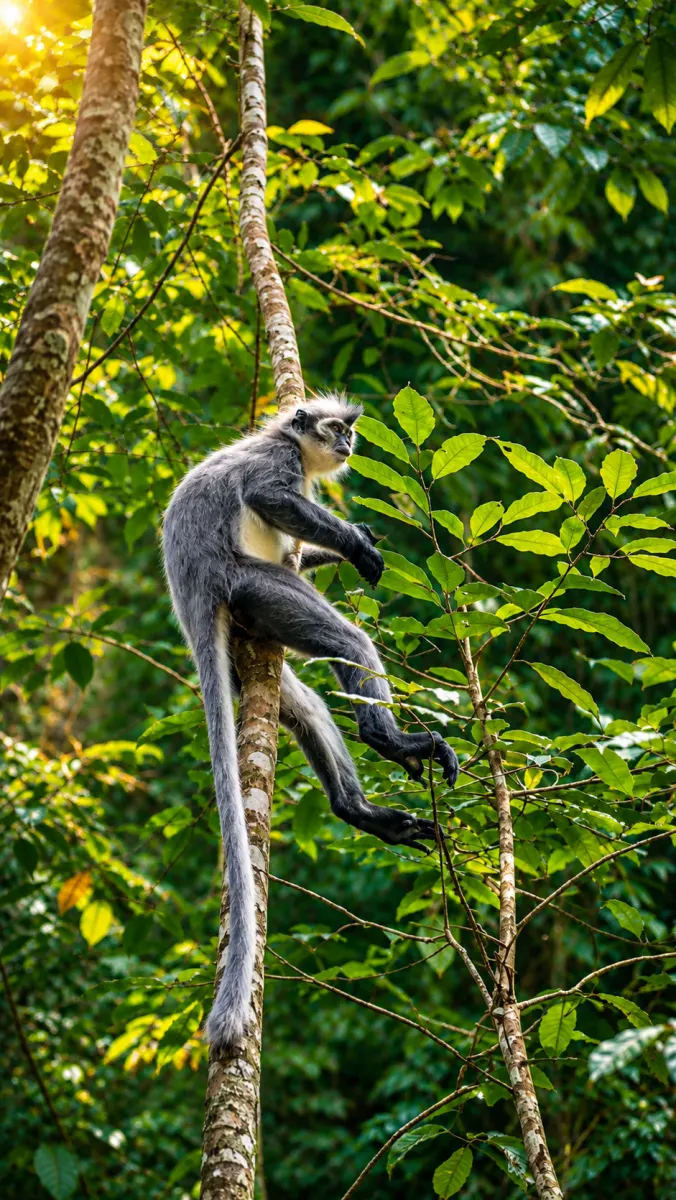
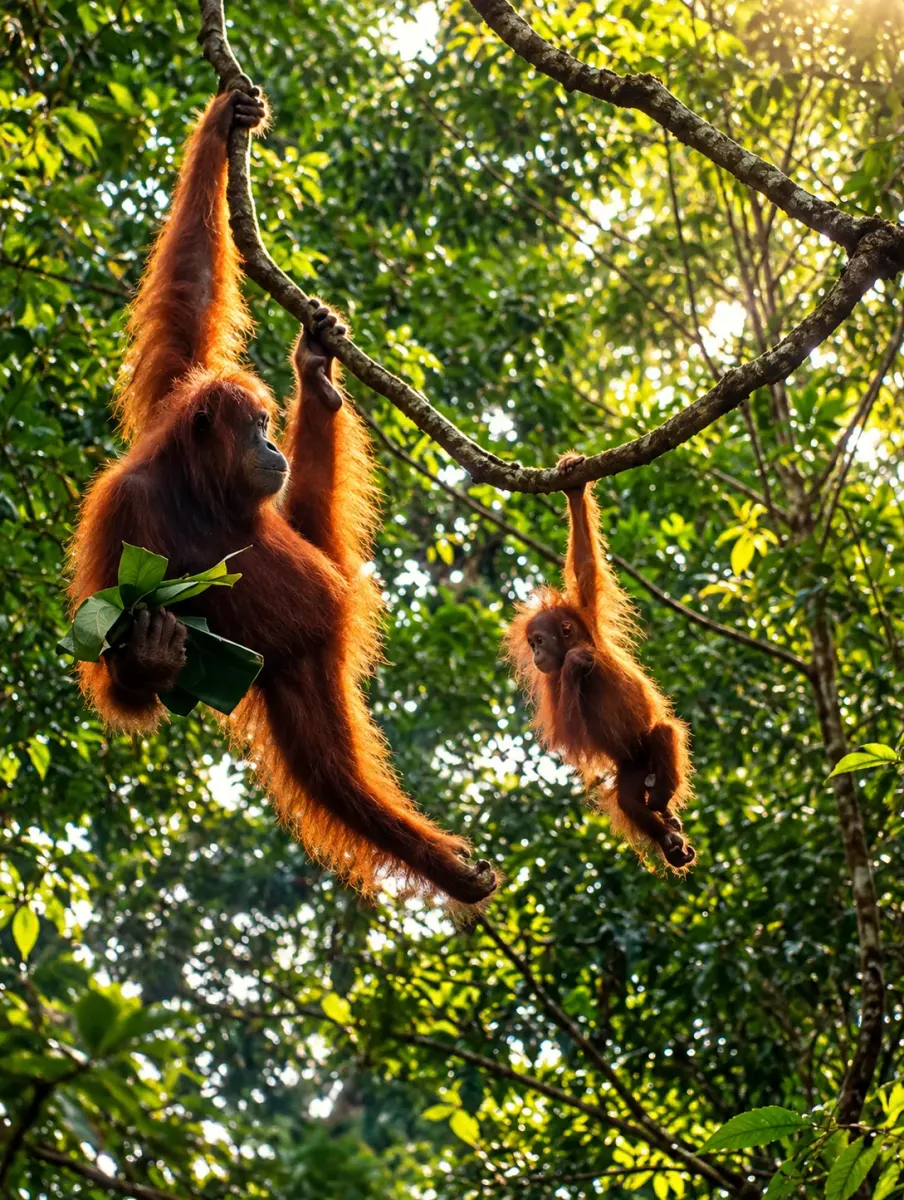
While most travelers come to Bukit Lawang dreaming of an encounter with the critically endangered Sumatran orangutan (Pongo abelii), almost every trekker leaves equally enchanted by another extraordinary canopy resident: the Thomas’s Leaf Monkey (Presbytis thomasi), known across North Sumatra and Aceh by its onomatopoeic local name, Kedih.

With its striking black-and-white tuxedo coat, dramatic upright "punk-rock mohawk" crest, and wide amber-orange eyes framed by white spectacles, the Kedih is one of the most photogenic—and biogeographically restricted—primates on Earth. This field guide explores the biology, multi-chambered leaf-digesting stomach, infant color change, and canopy behavior of Gunung Leuser’s iconic endemic langur.

1. Strictly Endemic to Northern Sumatra: The Wampu & Simpang Kiri River Barrier

Just like the Sumatran orangutan and the white-handed gibbon, the Thomas’s Leaf Monkey’s entire global range is restricted to the northern tip of Sumatra—specifically north of the Wampu River (in Langkat Regency) on the east coast and the Singkil / Simpang Kiri River on the west coast, covering the Gunung Leuser Ecosystem across North Sumatra and Aceh.

  • Why Do They Stop at the Wampu River? During Pleistocene glacial and volcanic cycles (including the massive Lake Toba super-eruption 74,000 years ago), major river basins acted as evolutionary barriers for strictly arboreal primates. Cross south of the Wampu River toward Berastagi and Lake Toba, and Presbytis thomasi is replaced by the East Sumatran banded langur (Presbytis percura) and mitered langur (Presbytis melalophos).
  • IUCN Conservation Status: Listed as Vulnerable (VU) on the IUCN Red List due to habitat fragmentation outside protected national park borders, making Bukit Lawang’s agroforestry buffer zone and primary dipterocarp ridges one of the most important strongholds for the species.
Interactive Primate Identification: Compare the Thomas’s Leaf Monkey alongside all 8 diurnal and nocturnal primates of Bohorok on our Gunung Leuser Interactive Wildlife Spotter Tool and our Complete Gunung Leuser Wildlife Field Guide.

2. Taxonomic & Field Identification Profile (Presbytis thomasi)

Biological Trait Field Specification in Gunung Leuser
Scientific & Local Names Presbytis thomasi • Local: Kedih (Karo/Indonesian) • English: Thomas’s Langur / Leaf Monkey
Adult Body Weight & Tail 5.0 to 7.5 kg (slender build) with a balancing tail longer than its body (65–80 cm)
Distinctive Facial Markings Tall V-shaped black-and-white crest ("mohawk"), white V-stripes above the eyes, dark charcoal back, pure white belly
Primary Forest Stratum Middle to Upper Canopy (12m–35m); occasionally descends to rubber groves & riverside fig trees
Social Structure One-male, multi-female family troops (typically 5–12 individuals) or small all-male bachelor bands
Spotting Probability in Bukit Lawang Very High on all treks (3-Hour Intro, 1-Day Discovery & 2D1N Camp)

3. Why Are They Called "Leaf Monkeys"? The Secret of Their Multi-Chambered Stomach

Unlike long-tailed and pig-tailed macaques (which have cheek pouches and opportunistic omnivorous diets), the Thomas’s Leaf Monkey belongs to the subfamily Colobinae—specialized arboreal folivores (leaf-eaters).

Mature tropical rainforest leaves are tough, fibrous, and packed with defensive plant tannins and alkaloids that would give most mammals severe indigestion. To unlock nutrition from leaves, Presbytis thomasi evolved a complex, sacculated multi-chambered stomach filled with symbiotic cellulolytic bacteria—functioning almost like a miniature cow’s rumen in the treetops!

  • What They Eat in Gunung Leuser: Young tender leaf shoots (pucuk daun) make up ~55% of their diet, supplemented by unripe wild figs, rubber tree seeds, forest flowers, and large caterpillars.
  • Why You must NEVER Feed Fruit or Bread to a Leaf Monkey: Because their foregut fermentation system is calibrated for low-sugar, high-fiber leaves, feeding sweet cultivated bananas, bread, or sugary snacks to a Kedih causes rapid gastric fermentation, dangerous bloating (acidosis), and can be fatal. This is why strict no-feeding rules are enforced by all HPI guides.

4. Snow-White Babies & "Alloparenting" in the Troop

If you trek in Bukit Lawang during a birth peak, you may spot a tiny infant clinging to its mother’s belly that looks completely different from the adults:

  • Born Creamy White with a Dark Dorsal Stripe: Newborn Thomas’s Leaf Monkeys are born with snow-white fur and a single dark stripe running down the spine and tail. Over their first 3 to 5 months of life, their coat gradually darkens into the adult slate-black and silver-white pattern.
  • Why Are Babies Bright White? Primatologists believe the high-contrast white coat triggers an instinctive caregiving response called allomothering (alloparenting). Adult and sub-adult females within the troop take turns holding, grooming, and protecting the infant while the mother forages—and if danger approaches, any female in the troop can immediately spot and scoop up the bright white baby.

5. How HPI Trackers Locate Kedih by Sound & Canopy Movement

On a morning walk through the Kapal or Landak valley, how do our guides spot leaf monkeys 25 meters up in dense foliage?

  1. The Staccato "Ke-dih! Ke-dih! Kuk-kuk-kuk!" Alarm & Contact Call: The resident adult male acts as the troop’s sentinel. At dawn—or whenever the troop detects an eagle, reticulated python, or clouded leopard—the male emits a sharp, resonant cough-rattle that echoes through the ravine, giving the monkey its local name Kedih.
  2. Spectacular 10-Meter Canopy Leaps: Unlike gibbons (which swing hand-over-hand beneath branches via brachiation) or orangutans (which clamber deliberately using all four limbs), Thomas’s Leaf Monkeys are explosive quadrupedal leapers. Using their powerful hind legs, they launch themselves across 8-to-10-meter gaps between tree crowns, crashing into flexible outer foliage with their long tail streaming behind as an aerodynamic rudder.
  3. Peaceful Personalities vs Macaques: Compared to bold long-tailed macaques (kera), Thomas’s Leaf Monkeys are gentle, curious, and non-aggressive. If your group stands quietly at a respectful 10-meter distance without making sudden movements, a Kedih troop will often continue feeding and grooming on mid-story branches right in front of your camera lens.

Want to Photograph the Thomas’s Leaf Monkey in the Wild? Check out our Rainforest Wildlife Photography Guide, explore our Ethical Gunung Leuser Trekking Packages, and test your primate knowledge on the Wildlife Spotter Tool!
Share This Guide With Your Travel Partner Planning a Sumatra expedition together?
WhatsApp Facebook X Telegram Email
Explore Bukit Lawang Team
Verified Guide & Author • 15+ Years in Leuser

Explore Bukit Lawang Team

HPI Member Guides, Wildlife Naturalists & Conservation Collective

The editorial and expedition team of Explore Bukit Lawang — local HPI member guides, primate trackers, river captains and conservation educators born along the Bohorok River.

Experience Gunung Leuser In Person

Ready to Trek with Our Local HPI Guides?

National park permits, small private groups, and traditional river tubing included on every expedition.
Wildlife & Nature • 9 min read • 71 views • November 09, 2026
Thomas Leaf Monkey (Kedih): North Sumatra Endemic Primate

Meet the Thomas Leaf Monkey (Presbytis thomasi), locally called Kedih: North Sumatra’s endemic mohawk-crested primate in Gunung Leuser National Park.

Explore Bukit Lawang Team
Explore Bukit Lawang Team HPI Member Guides, Wildlife Naturalists & Conservation Collective

While most travelers come to Bukit Lawang dreaming of an encounter with the critically endangered Sumatran orangutan (Pongo abelii), almost every trekker leaves equally enchanted by another extraordinary canopy resident: the Thomas’s Leaf Monkey (Presbytis thomasi), known across North Sumatra and Aceh by its onomatopoeic local name, Kedih.

With its striking black-and-white tuxedo coat, dramatic upright "punk-rock mohawk" crest, and wide amber-orange eyes framed by white spectacles, the Kedih is one of the most photogenic—and biogeographically restricted—primates on Earth. This field guide explores the biology, multi-chambered leaf-digesting stomach, infant color change, and canopy behavior of Gunung Leuser’s iconic endemic langur.

1. Strictly Endemic to Northern Sumatra: The Wampu & Simpang Kiri River Barrier

Just like the Sumatran orangutan and the white-handed gibbon, the Thomas’s Leaf Monkey’s entire global range is restricted to the northern tip of Sumatra—specifically north of the Wampu River (in Langkat Regency) on the east coast and the Singkil / Simpang Kiri River on the west coast, covering the Gunung Leuser Ecosystem across North Sumatra and Aceh.

  • Why Do They Stop at the Wampu River? During Pleistocene glacial and volcanic cycles (including the massive Lake Toba super-eruption 74,000 years ago), major river basins acted as evolutionary barriers for strictly arboreal primates. Cross south of the Wampu River toward Berastagi and Lake Toba, and Presbytis thomasi is replaced by the East Sumatran banded langur (Presbytis percura) and mitered langur (Presbytis melalophos).
  • IUCN Conservation Status: Listed as Vulnerable (VU) on the IUCN Red List due to habitat fragmentation outside protected national park borders, making Bukit Lawang’s agroforestry buffer zone and primary dipterocarp ridges one of the most important strongholds for the species.
Interactive Primate Identification: Compare the Thomas’s Leaf Monkey alongside all 8 diurnal and nocturnal primates of Bohorok on our Gunung Leuser Interactive Wildlife Spotter Tool and our Complete Gunung Leuser Wildlife Field Guide.

2. Taxonomic & Field Identification Profile (Presbytis thomasi)

Biological Trait Field Specification in Gunung Leuser
Scientific & Local Names Presbytis thomasi • Local: Kedih (Karo/Indonesian) • English: Thomas’s Langur / Leaf Monkey
Adult Body Weight & Tail 5.0 to 7.5 kg (slender build) with a balancing tail longer than its body (65–80 cm)
Distinctive Facial Markings Tall V-shaped black-and-white crest ("mohawk"), white V-stripes above the eyes, dark charcoal back, pure white belly
Primary Forest Stratum Middle to Upper Canopy (12m–35m); occasionally descends to rubber groves & riverside fig trees
Social Structure One-male, multi-female family troops (typically 5–12 individuals) or small all-male bachelor bands
Spotting Probability in Bukit Lawang Very High on all treks (3-Hour Intro, 1-Day Discovery & 2D1N Camp)

3. Why Are They Called "Leaf Monkeys"? The Secret of Their Multi-Chambered Stomach

Unlike long-tailed and pig-tailed macaques (which have cheek pouches and opportunistic omnivorous diets), the Thomas’s Leaf Monkey belongs to the subfamily Colobinae—specialized arboreal folivores (leaf-eaters).

Mature tropical rainforest leaves are tough, fibrous, and packed with defensive plant tannins and alkaloids that would give most mammals severe indigestion. To unlock nutrition from leaves, Presbytis thomasi evolved a complex, sacculated multi-chambered stomach filled with symbiotic cellulolytic bacteria—functioning almost like a miniature cow’s rumen in the treetops!

  • What They Eat in Gunung Leuser: Young tender leaf shoots (pucuk daun) make up ~55% of their diet, supplemented by unripe wild figs, rubber tree seeds, forest flowers, and large caterpillars.
  • Why You must NEVER Feed Fruit or Bread to a Leaf Monkey: Because their foregut fermentation system is calibrated for low-sugar, high-fiber leaves, feeding sweet cultivated bananas, bread, or sugary snacks to a Kedih causes rapid gastric fermentation, dangerous bloating (acidosis), and can be fatal. This is why strict no-feeding rules are enforced by all HPI guides.

4. Snow-White Babies & "Alloparenting" in the Troop

If you trek in Bukit Lawang during a birth peak, you may spot a tiny infant clinging to its mother’s belly that looks completely different from the adults:

  • Born Creamy White with a Dark Dorsal Stripe: Newborn Thomas’s Leaf Monkeys are born with snow-white fur and a single dark stripe running down the spine and tail. Over their first 3 to 5 months of life, their coat gradually darkens into the adult slate-black and silver-white pattern.
  • Why Are Babies Bright White? Primatologists believe the high-contrast white coat triggers an instinctive caregiving response called allomothering (alloparenting). Adult and sub-adult females within the troop take turns holding, grooming, and protecting the infant while the mother forages—and if danger approaches, any female in the troop can immediately spot and scoop up the bright white baby.

5. How HPI Trackers Locate Kedih by Sound & Canopy Movement

On a morning walk through the Kapal or Landak valley, how do our guides spot leaf monkeys 25 meters up in dense foliage?

  1. The Staccato "Ke-dih! Ke-dih! Kuk-kuk-kuk!" Alarm & Contact Call: The resident adult male acts as the troop’s sentinel. At dawn—or whenever the troop detects an eagle, reticulated python, or clouded leopard—the male emits a sharp, resonant cough-rattle that echoes through the ravine, giving the monkey its local name Kedih.
  2. Spectacular 10-Meter Canopy Leaps: Unlike gibbons (which swing hand-over-hand beneath branches via brachiation) or orangutans (which clamber deliberately using all four limbs), Thomas’s Leaf Monkeys are explosive quadrupedal leapers. Using their powerful hind legs, they launch themselves across 8-to-10-meter gaps between tree crowns, crashing into flexible outer foliage with their long tail streaming behind as an aerodynamic rudder.
  3. Peaceful Personalities vs Macaques: Compared to bold long-tailed macaques (kera), Thomas’s Leaf Monkeys are gentle, curious, and non-aggressive. If your group stands quietly at a respectful 10-meter distance without making sudden movements, a Kedih troop will often continue feeding and grooming on mid-story branches right in front of your camera lens.
Want to Photograph the Thomas’s Leaf Monkey in the Wild? Check out our Rainforest Wildlife Photography Guide, explore our Ethical Gunung Leuser Trekking Packages, and test your primate knowledge on the Wildlife Spotter Tool!
You have reached the end of this field dispatch

Written by local HPI member guides from Bukit Lawang. If you have questions about packing, permits, or trail conditions, reach out anytime.

Chat with Guide on WhatsApp

Park Permit Assistance

Facilitated at Balai Besar TNGL checkpoints

Ethical Jungle Trekking

Zero feeding & 10m distance policy

Traditional River Tubing

Safety gear & skilled river captains

Works Fully Offline

Guides work deep inside rainforest