Trail & River Advisory
Orangutan Nests, Diet & Behavior in Gunung Leuser
Click to enlarge

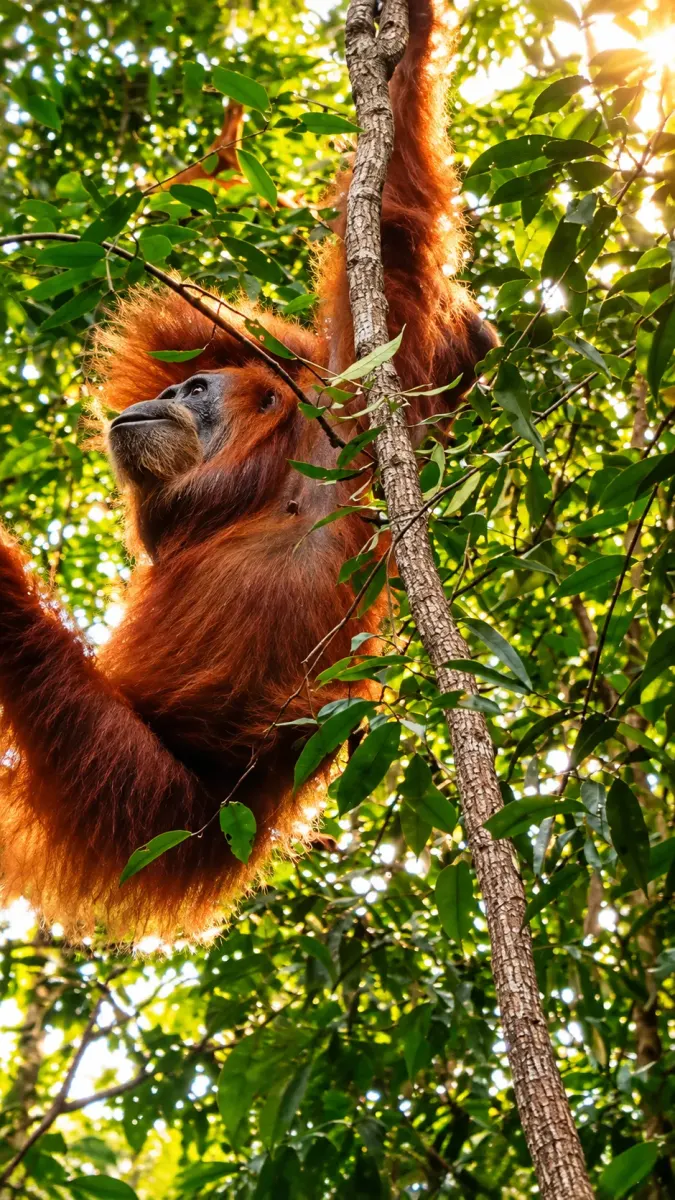
To watch a wild Sumatran orangutan (Pongo abelii) navigating the high canopy of Gunung Leuser National Park is to witness one of the most astonishing displays of arboreal intelligence on our planet. Unlike their Bornean relatives who frequently descend to the forest floor, Sumatran orangutans spend almost 99% of their lives aloft—building complex architectural nests, memorizing hundreds of fruiting trees across vast territories, and passing cultural tool-use traditions down through generations.

€
Guide rates in this article are displayed in: EUR (€) Automatically converted from standard HPI Langkat reference tariffs (Base: EUR).
Switch currency in top header

1. The Canopy Architects: How Orangutans Build Night Nests

Every single evening as dusk approaches the rainforest canopy, wild orangutans undertake an essential engineering task: constructing a fresh, elevated sleeping platform. An adult orangutan builds a brand-new nest every day, rarely reusing an old structure to avoid parasite infestation and weak structural timber.

Canopy Nest Engineering Phases

  1. Site Selection: The orangutan selects a sturdy fork in a primary canopy tree, typically between 15 and 30 meters above the jungle floor, well out of reach of terrestrial predators.
  2. Structural Foundation: Thick, living branches are bent inward without snapping, forming an elastic, interwoven basket-like foundation that can support weights exceeding 80 kilograms.
  3. Mattress Weaving: Smaller leafy twigs are folded back and forth across the base, creating a resilient, springy mattress that contours to the ape’s body.
  4. Pillows, Blankets & Roofs: In a remarkable display of comfort awareness, orangutans gather soft leaf bunches to serve as pillows. When tropical rainstorms strike, they weave protective overhead "leaf umbrellas" (payung daun) to stay dry through the night.

For HPI member wilderness guides, abandoned nests are crucial tracking indicators. By inspecting the coloration of the leaves in a canopy nest—bright green indicating construction within 24 hours, yellowing leaves signifying two to four days, and brittle brown foliage indicating a week or older—trackers can accurately chart the resident orangutans' foraging corridor.

2. The Leuser Diet: Over 400 Species of Wild Foods

Sumatran orangutans are primarily frugivores, but their rainforest pantry is extraordinarily diverse. Research across the Leuser Ecosystem indicates that orangutans feed on more than 400 distinct plant and insect species throughout the year:

Food Category Key Forest Species Ecological Importance
Wild Figs (Ficus spp.) Over 30 strangler fig and river fig varieties The ultimate keystone food source, providing sugars and fiber during lean seasons
Forest Canopy Fruits Wild durian, jackfruit (Artocarpus), rambutan, mangosteen, Neesia High-calorie lipids and simple carbohydrates that build fat reserves
Inner Tree Bark & Cambium Fibrous cambium layers stripped from select lianas and trees Survival food during low-fruiting periods; high in structural fiber
Insects & Honey Termites, carpenter ants, and stingless bee honey (madu kelulut) Vital animal protein, essential amino acids, and minerals
Geophagy (Soil & Termite Mounds) Mineral-rich clay soils and riverbed silt Neutralizes dietary tannins and toxins absorbed from bitter leaves

Because fruit availability fluctuates drastically with the seasons, orangutans maintain an astounding cognitive spatial map of the jungle. Mothers remember the exact geographical location and fruiting cycles of hundreds of individual trees across a home range extending over several square kilometers.

3. Tool Use & Cultural Transmission

One of the scientific breakthroughs in modern primatology was the discovery that Sumatran orangutans exhibit distinct tool-use cultures. While tool use was once thought to be unique to chimpanzees and humans, field biologists in northern Sumatra documented wild orangutans fashioning sophisticated wooden implements:

  • The Neesia Seed Tool: The woody capsule of the Neesia fruit contains highly nutritious, fat-rich seeds protected by thousands of microscopic, needle-sharp irritant hairs. Rather than risk painful mouth irritation, orangutans snap small twigs, strip the bark with their teeth, and insert the blunt stick into the fruit crevices to extract the seeds cleanly.
  • Insect Probing Sticks: Orangutans craft fine, flexible probes to harvest termites and ants from hollow tree trunks without enduring defensive bites.
  • Honey Extractors: Thick, flattened sticks are used as spoons to break into the wax pots of stingless bees (Heterotrigona) high in tree hollows.
  • Leaf Sponges & Gloves: Leaves are chewed into absorbent pads to soak up water from deep tree holes or folded into protective mitts to handle spiny rattan stems.

Crucially, these behaviors are not purely instinctive; they are learned cultural practices passed down socially from mother to infant over many years of close observation.

4. The Mother-Infant Bond: Nature’s Longest Childhood

Aside from humans, wild orangutans possess the longest childhood and maternal dependency of any terrestrial mammal on Earth:

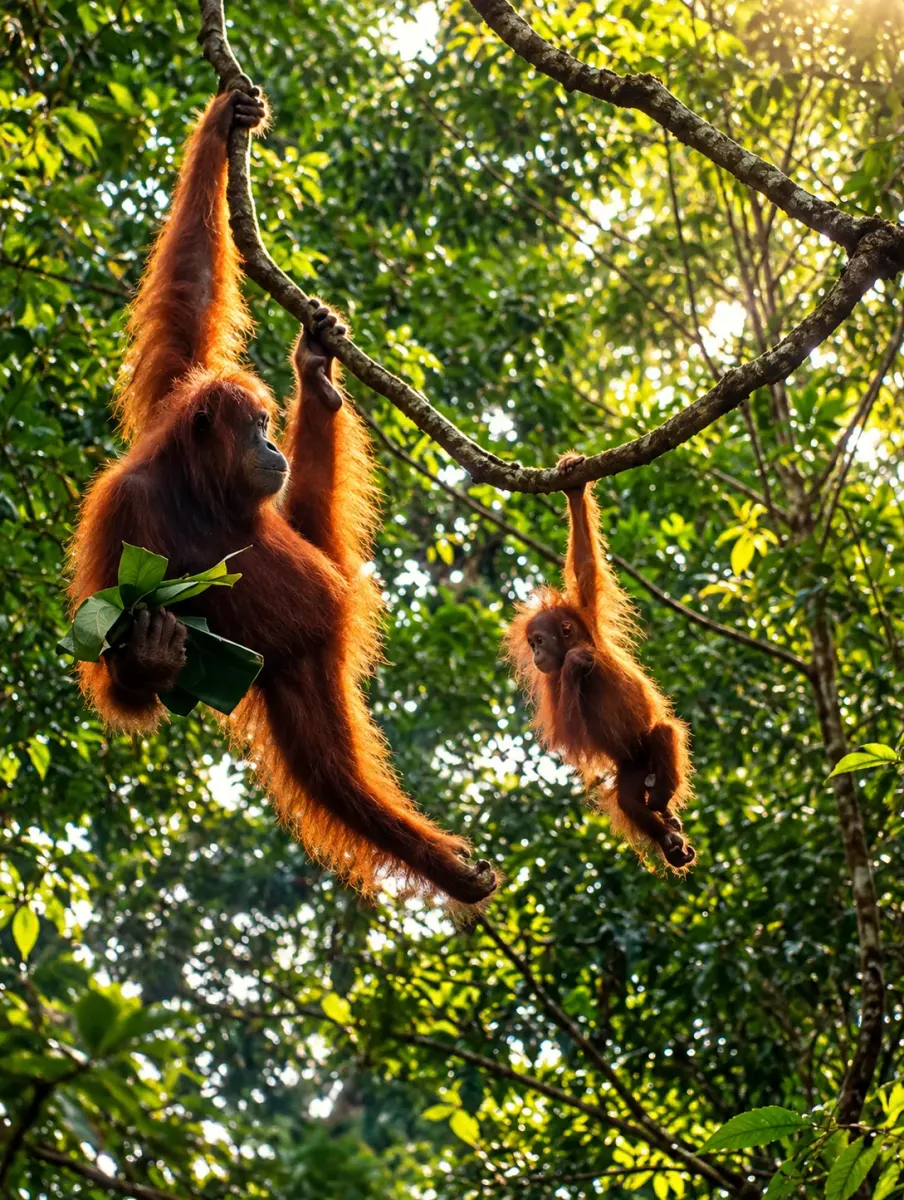
  • Continuous Contact (Years 0–2): For the first two years of life, an infant never leaves physical contact with its mother’s body, clinging firmly to her long belly and chest hair as she swings through the canopy.
  • The Apprenticeship (Years 3–8): The young orangutan begins exploring nearby branches but sleeps in its mother's nest every night. During this lengthy apprenticeship, the mother teaches her offspring what to eat, which fruits are poisonous, how to navigate the seasonal canopy, and how to build weatherproof nests.
  • Low Reproductive Rate: Female orangutans only give birth once every 8 to 9 years. Because a female may rear only four to five offspring in her entire 45-to-50-year lifespan, even minimal adult mortality can drive local populations toward extinction.

Why High-Spotting Corridors Exist in Bukit Lawang

Thanks to decades of community protection by HPI member guides and the legacy of the historic rehabilitation program (1973–early 2000s), Bukit Lawang hosts both fully wild orangutans and second-generation forest-born individuals. This unique ecological zone provides exceptional spotting opportunities while upholding rigorous non-intervention rules.

5. Ethical Observation: Protecting Great Apes on the Trail

Because humans share approximately 97% of our genetic sequence with orangutans, our proximity poses severe biological risks. A common human respiratory virus, influenza, or gastrointestinal pathogen can prove fatal to wild apes who lack antibodies. When encountering wild orangutans during a jungle trek, visitors must adhere to strict guidelines:

  1. The 10-Meter Buffer: Always maintain at least a 10-meter (33-foot) distance. If an orangutan moves closer along lower branches, visitors must quietly and calmly step back.
  2. Zero Feeding or Baiting: Never offer food. Handouts disrupt natural foraging instincts, cause dental decay, and turn peaceful wild apes into aggressive beggars.
  3. Pack Away Food Immediately: If primates approach while you are eating lunch, zip your daypack shut and move away.
  4. Silence and Respect: Keep voices low and movements gentle. Flash photography is strictly forbidden as it causes intense disorientation.
  5. Health Clearance: If you are feeling sick with a cough, flu, or fever, refrain from trekking until you have fully recovered.

6. Frequently Asked Questions (FAQ)

Do orangutans sleep in the same nest every night?

No. Wild orangutans build a brand-new nest every single afternoon. Reusing old nests is very rare and only occurs during extreme emergencies, because used nests accumulate parasites and weak branches lose structural elasticity.

Why do Sumatran orangutans stay in the trees more than Bornean orangutans?

The primary reason is the presence of the Sumatran tiger (Panthera tigris sumatrae) on the forest floor in Sumatra. In Borneo, where tigers are absent, male orangutans spend considerable time walking along trails. In Sumatra, canopy living is a vital survival adaptation.

How can trackers tell an orangutan nest from a bird nest?

Orangutan nests are substantially larger (often 1 to 1.5 meters across) and feature cleanly bent, interwoven leafy branches rather than twigs gathered and glued with mud or saliva. They are positioned in secure tree forks high in the mid-to-upper canopy.

What is the best trek duration to observe wild behavior?

While a 1-Day Jungle Trek offers high spotting probabilities, multi-day treks such as our 2-Day Trek or 3-Day Expedition lead you deeper into pristine primary forest corridors where you can observe wild foraging and evening nest building firsthand.

Observe Wild Great Apes with Local Leuser Trackers

Join HPI member guides dedicated to ethical wildlife observation and rainforest habitat conservation in Gunung Leuser National Park.

View Trekking Expeditions Read Ethical Guidelines

Share This Guide With Your Travel Partner Planning a Sumatra expedition together?
WhatsApp Facebook X Telegram Email
Explore Bukit Lawang Team
Verified Guide & Author • 15+ Years in Leuser

Explore Bukit Lawang Team

HPI Member Guides, Wildlife Naturalists & Conservation Collective

The editorial and expedition team of Explore Bukit Lawang — local HPI member guides, primate trackers, river captains and conservation educators born along the Bohorok River.

Experience Gunung Leuser In Person

Ready to Trek with Our Local HPI Guides?

National park permits, small private groups, and traditional river tubing included on every expedition.
Wildlife & Nature • 8 min read • 16 views • November 21, 2026
Orangutan Nests, Diet & Behavior in Gunung Leuser

Discover how wild Sumatran orangutans build canopy nests, forage over 400 plant species, use tools & raise infants for 8 years in Gunung Leuser National Park.

Explore Bukit Lawang Team
Explore Bukit Lawang Team HPI Member Guides, Wildlife Naturalists & Conservation Collective

To watch a wild Sumatran orangutan (Pongo abelii) navigating the high canopy of Gunung Leuser National Park is to witness one of the most astonishing displays of arboreal intelligence on our planet. Unlike their Bornean relatives who frequently descend to the forest floor, Sumatran orangutans spend almost 99% of their lives aloft—building complex architectural nests, memorizing hundreds of fruiting trees across vast territories, and passing cultural tool-use traditions down through generations.

€
Guide rates in this article are displayed in: EUR (€) Automatically converted from standard HPI Langkat reference tariffs (Base: EUR).
Switch currency in top header

1. The Canopy Architects: How Orangutans Build Night Nests

Every single evening as dusk approaches the rainforest canopy, wild orangutans undertake an essential engineering task: constructing a fresh, elevated sleeping platform. An adult orangutan builds a brand-new nest every day, rarely reusing an old structure to avoid parasite infestation and weak structural timber.

Canopy Nest Engineering Phases

  1. Site Selection: The orangutan selects a sturdy fork in a primary canopy tree, typically between 15 and 30 meters above the jungle floor, well out of reach of terrestrial predators.
  2. Structural Foundation: Thick, living branches are bent inward without snapping, forming an elastic, interwoven basket-like foundation that can support weights exceeding 80 kilograms.
  3. Mattress Weaving: Smaller leafy twigs are folded back and forth across the base, creating a resilient, springy mattress that contours to the ape’s body.
  4. Pillows, Blankets & Roofs: In a remarkable display of comfort awareness, orangutans gather soft leaf bunches to serve as pillows. When tropical rainstorms strike, they weave protective overhead "leaf umbrellas" (payung daun) to stay dry through the night.

For HPI member wilderness guides, abandoned nests are crucial tracking indicators. By inspecting the coloration of the leaves in a canopy nest—bright green indicating construction within 24 hours, yellowing leaves signifying two to four days, and brittle brown foliage indicating a week or older—trackers can accurately chart the resident orangutans' foraging corridor.

2. The Leuser Diet: Over 400 Species of Wild Foods

Sumatran orangutans are primarily frugivores, but their rainforest pantry is extraordinarily diverse. Research across the Leuser Ecosystem indicates that orangutans feed on more than 400 distinct plant and insect species throughout the year:

Food Category Key Forest Species Ecological Importance
Wild Figs (Ficus spp.) Over 30 strangler fig and river fig varieties The ultimate keystone food source, providing sugars and fiber during lean seasons
Forest Canopy Fruits Wild durian, jackfruit (Artocarpus), rambutan, mangosteen, Neesia High-calorie lipids and simple carbohydrates that build fat reserves
Inner Tree Bark & Cambium Fibrous cambium layers stripped from select lianas and trees Survival food during low-fruiting periods; high in structural fiber
Insects & Honey Termites, carpenter ants, and stingless bee honey (madu kelulut) Vital animal protein, essential amino acids, and minerals
Geophagy (Soil & Termite Mounds) Mineral-rich clay soils and riverbed silt Neutralizes dietary tannins and toxins absorbed from bitter leaves

Because fruit availability fluctuates drastically with the seasons, orangutans maintain an astounding cognitive spatial map of the jungle. Mothers remember the exact geographical location and fruiting cycles of hundreds of individual trees across a home range extending over several square kilometers.

3. Tool Use & Cultural Transmission

One of the scientific breakthroughs in modern primatology was the discovery that Sumatran orangutans exhibit distinct tool-use cultures. While tool use was once thought to be unique to chimpanzees and humans, field biologists in northern Sumatra documented wild orangutans fashioning sophisticated wooden implements:

  • The Neesia Seed Tool: The woody capsule of the Neesia fruit contains highly nutritious, fat-rich seeds protected by thousands of microscopic, needle-sharp irritant hairs. Rather than risk painful mouth irritation, orangutans snap small twigs, strip the bark with their teeth, and insert the blunt stick into the fruit crevices to extract the seeds cleanly.
  • Insect Probing Sticks: Orangutans craft fine, flexible probes to harvest termites and ants from hollow tree trunks without enduring defensive bites.
  • Honey Extractors: Thick, flattened sticks are used as spoons to break into the wax pots of stingless bees (Heterotrigona) high in tree hollows.
  • Leaf Sponges & Gloves: Leaves are chewed into absorbent pads to soak up water from deep tree holes or folded into protective mitts to handle spiny rattan stems.

Crucially, these behaviors are not purely instinctive; they are learned cultural practices passed down socially from mother to infant over many years of close observation.

4. The Mother-Infant Bond: Nature’s Longest Childhood

Aside from humans, wild orangutans possess the longest childhood and maternal dependency of any terrestrial mammal on Earth:

  • Continuous Contact (Years 0–2): For the first two years of life, an infant never leaves physical contact with its mother’s body, clinging firmly to her long belly and chest hair as she swings through the canopy.
  • The Apprenticeship (Years 3–8): The young orangutan begins exploring nearby branches but sleeps in its mother's nest every night. During this lengthy apprenticeship, the mother teaches her offspring what to eat, which fruits are poisonous, how to navigate the seasonal canopy, and how to build weatherproof nests.
  • Low Reproductive Rate: Female orangutans only give birth once every 8 to 9 years. Because a female may rear only four to five offspring in her entire 45-to-50-year lifespan, even minimal adult mortality can drive local populations toward extinction.

Why High-Spotting Corridors Exist in Bukit Lawang

Thanks to decades of community protection by HPI member guides and the legacy of the historic rehabilitation program (1973–early 2000s), Bukit Lawang hosts both fully wild orangutans and second-generation forest-born individuals. This unique ecological zone provides exceptional spotting opportunities while upholding rigorous non-intervention rules.

5. Ethical Observation: Protecting Great Apes on the Trail

Because humans share approximately 97% of our genetic sequence with orangutans, our proximity poses severe biological risks. A common human respiratory virus, influenza, or gastrointestinal pathogen can prove fatal to wild apes who lack antibodies. When encountering wild orangutans during a jungle trek, visitors must adhere to strict guidelines:

  1. The 10-Meter Buffer: Always maintain at least a 10-meter (33-foot) distance. If an orangutan moves closer along lower branches, visitors must quietly and calmly step back.
  2. Zero Feeding or Baiting: Never offer food. Handouts disrupt natural foraging instincts, cause dental decay, and turn peaceful wild apes into aggressive beggars.
  3. Pack Away Food Immediately: If primates approach while you are eating lunch, zip your daypack shut and move away.
  4. Silence and Respect: Keep voices low and movements gentle. Flash photography is strictly forbidden as it causes intense disorientation.
  5. Health Clearance: If you are feeling sick with a cough, flu, or fever, refrain from trekking until you have fully recovered.

6. Frequently Asked Questions (FAQ)

Do orangutans sleep in the same nest every night?

No. Wild orangutans build a brand-new nest every single afternoon. Reusing old nests is very rare and only occurs during extreme emergencies, because used nests accumulate parasites and weak branches lose structural elasticity.

Why do Sumatran orangutans stay in the trees more than Bornean orangutans?

The primary reason is the presence of the Sumatran tiger (Panthera tigris sumatrae) on the forest floor in Sumatra. In Borneo, where tigers are absent, male orangutans spend considerable time walking along trails. In Sumatra, canopy living is a vital survival adaptation.

How can trackers tell an orangutan nest from a bird nest?

Orangutan nests are substantially larger (often 1 to 1.5 meters across) and feature cleanly bent, interwoven leafy branches rather than twigs gathered and glued with mud or saliva. They are positioned in secure tree forks high in the mid-to-upper canopy.

What is the best trek duration to observe wild behavior?

While a 1-Day Jungle Trek offers high spotting probabilities, multi-day treks such as our 2-Day Trek or 3-Day Expedition lead you deeper into pristine primary forest corridors where you can observe wild foraging and evening nest building firsthand.

Observe Wild Great Apes with Local Leuser Trackers

Join HPI member guides dedicated to ethical wildlife observation and rainforest habitat conservation in Gunung Leuser National Park.

View Trekking Expeditions Read Ethical Guidelines
You have reached the end of this field dispatch

Written by local HPI member guides from Bukit Lawang. If you have questions about packing, permits, or trail conditions, reach out anytime.

Chat with Guide on WhatsApp

Park Permit Assistance

Facilitated at Balai Besar TNGL checkpoints

Ethical Jungle Trekking

Zero feeding & 10m distance policy

Traditional River Tubing

Safety gear & skilled river captains

Works Fully Offline

Guides work deep inside rainforest