Discover the acoustic canopy of Gunung Leuser: white-handed gibbons and siamangs. Learn why their dawn calls echo across Bukit Lawang & where to spot them.
Every morning between 05:45 and 07:30 WIB, as mist rises from the Bohorok River and night gives way to dawn, the ancient canopy of Gunung Leuser National Park erupts in one of nature’s most haunting acoustic spectacles: the territorial morning chorus of White-Handed Gibbons and Siamangs.
Their rising, operatic duets and booming bass calls echo across the river gorges, waking travelers in their eco-lodge beds long before alarm clocks ring. For many visitors, listening to this primeval dawn symphony is the exact moment they realize they are standing on the threshold of wild Sumatra. This field guide explores the biology of Leuser’s singing apes, how Siamangs inflate their throat sacs to amplify sound across kilometers, and how to spot them swinging 35 meters above the forest floor.
1. The Two Singing Apes of Bukit Lawang: Gibbons vs Siamangs
While often lumped together in casual conversation, the White-Handed Gibbon and the Siamang are distinct members of the small ape family (Hylobatidae). Both reside within the primary rainforest surrounding Bukit Lawang, yet each possesses unique biological adaptations and vocal signatures:
| Trait | White-Handed Gibbon (Hylobates lar) | Siamang (Symphalangus syndactylus) |
|---|---|---|
| Local Name (Indonesian / Karo) | Owa Serudung / Owa Lar | Siamang |
| Adult Body Weight | 5.0 to 7.5 kg (slender & agile) | 10.0 to 14.0 kg (largest gibbon on Earth) |
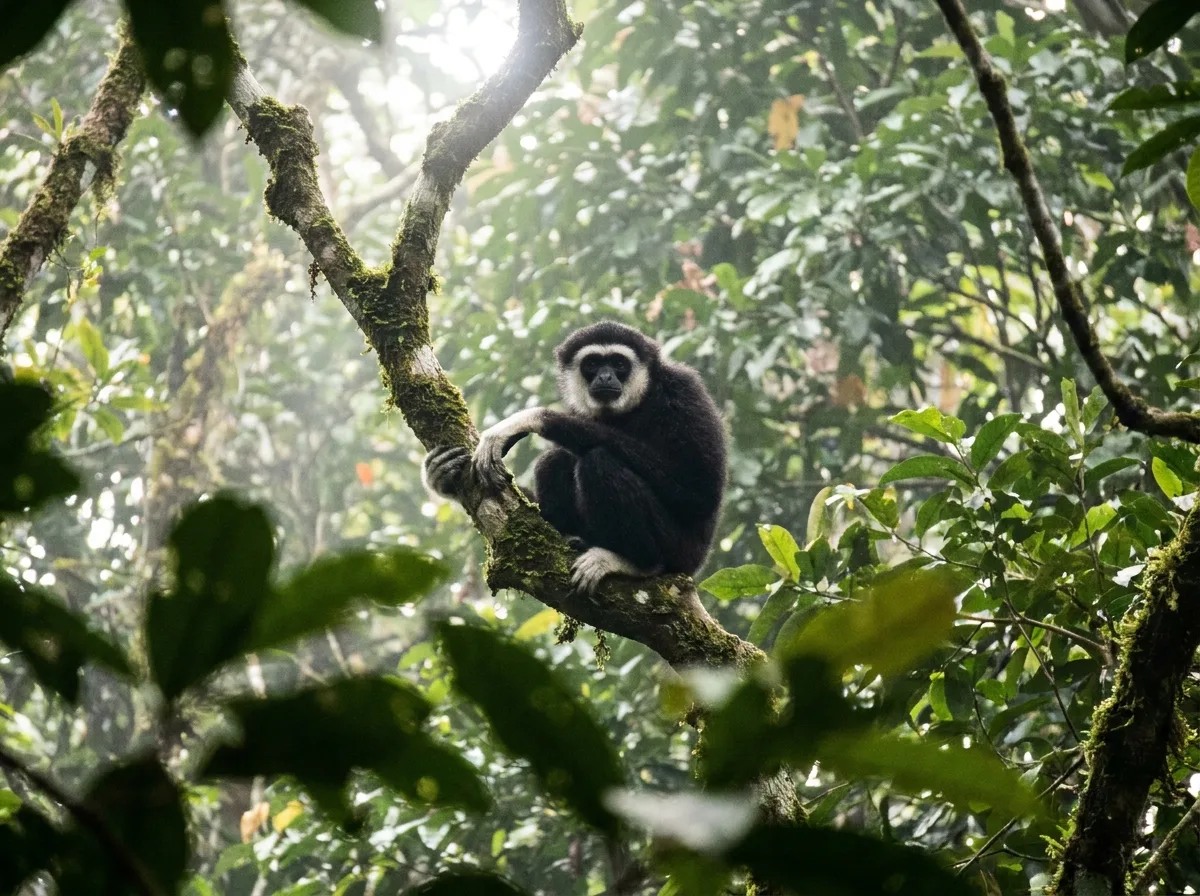
| Physical Coloration | Creamy white hands and feet, dark face encircled by a white fur ring; body color ranges from dark brown to honey-tan | Dense, glossy jet-black fur across the entire body; distinctive webbed second and third toes |
| Vocal Apparatus | Internal laryngeal air sacs producing clear, high-pitched ascending sirens and musical whoops | Massive external inflatable throat sac (gular sac) that swells to the size of a grapefruit, acting as an acoustic resonator |
| Acoustic Range | Heard up to 1.0 to 1.5 km away | Thunderous booming bellows audible up to 2.5 to 3.0 km across limestone river canyons |
| IUCN Conservation Status | Endangered (EN) | Endangered (EN) |
2. Why Do Gibbons Sing? The Science of Canopy Duets
Gibbons and Siamangs do not sing purely for pleasure; their dawn songs serve precise evolutionary functions essential for survival in a dense, low-visibility tropical rainforest:
- Territorial Defense Without Physical Violence: A single monogamous gibbon family defends an exclusive canopy territory of 20 to 40 hectares filled with fruit trees. In thick foliage where neighboring groups cannot see each other, acoustic advertising stakes a claim to the territory. When a neighboring pair hears the loud call, they recognize that the fruit groves are occupied, avoiding costly physical fights.
- Pair-Bond Reinforcement (Complex Antiphonal Duets): Mated gibbon pairs sing synchronized duets that take months or years of practice to coordinate. The female leads with a dramatic, rising "Great Call" that accelerates into an operatic crescendo, while the male provides rhythmic supporting whoops and acrobatic bark displays. Biologists consider these synchronized duets a sign of strong pair bonds.
- Location Tracking Among Family Members: Sub-adult offspring participate in the chorus, learning the vocal patterns that they will later use when establishing their own territories upon reaching sexual maturity at around 8 to 10 years of age.
3. Masters of Brachiation: Flying Through the Emergent Canopy
Watching a White-Handed Gibbon move through the rainforest crown is a lesson in biomechanics. Gibbons are the undisputed masters of brachiation—swinging hand-over-hand from branch to branch beneath tree limbs:
- Ball-and-Socket Wrist Joints: Unlike human wrists, a gibbon’s wrist contains an evolutionary ball-and-socket joint that allows its body to rotate 360 degrees beneath an arm without straining the shoulder or elbow.
- Hook-Like Fingers: Their four long fingers form a natural hook, while the thumb is separated down near the wrist, allowing them to release and grab branches in split-second sequences at speeds exceeding 35 km/h across 10-meter canopy chasms.
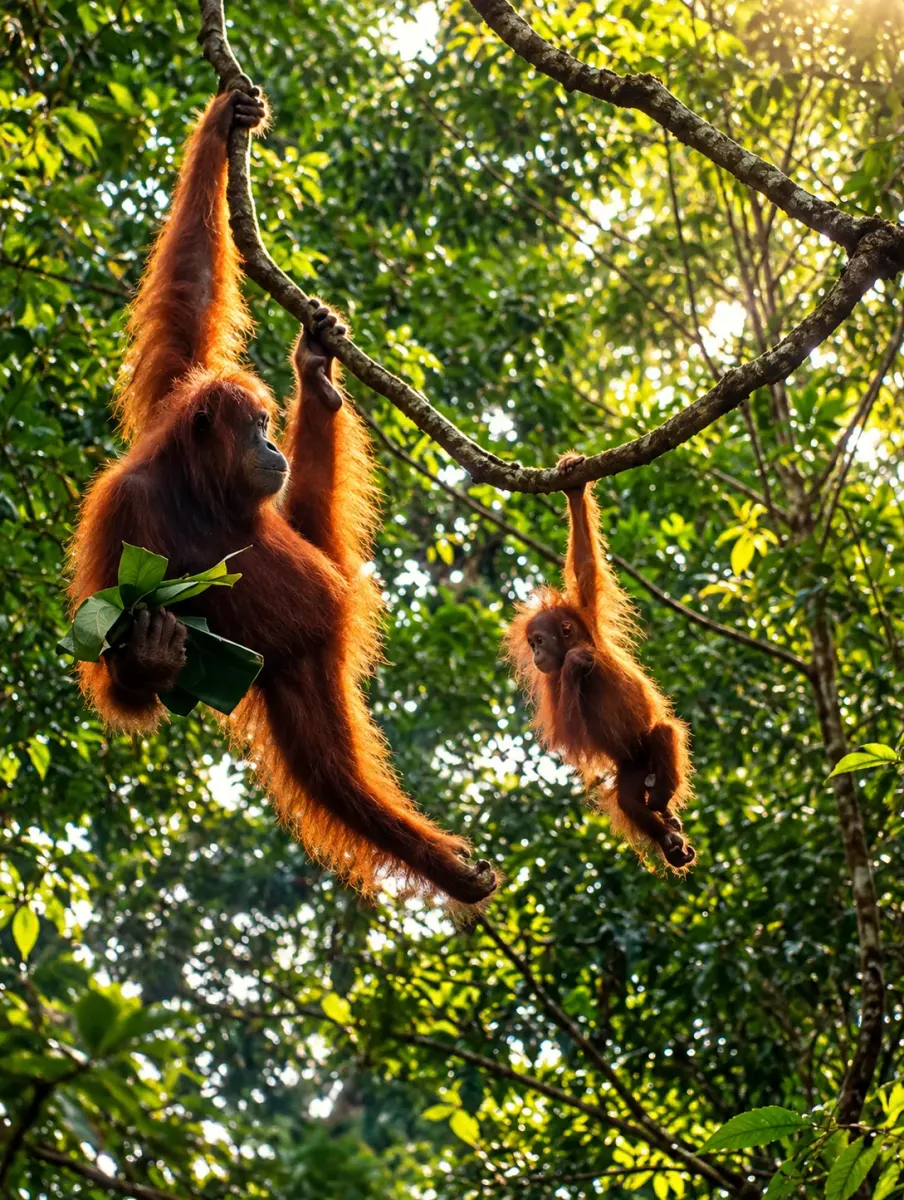
- Why They Never Walk on the Ground: While captive gibbons or zoo animals might occasionally walk bipedally on the ground, truly wild Sumatran gibbons virtually never descend to the jungle floor. With ancestral ground predators like the Sumatran tiger (Panthera tigris sumatrae) and clouded leopard (Neofelis diardi) prowling below, remaining in the 25–40m emergent canopy is essential for survival—a life strategy shared with wild Sumatran orangutans.
4. How and Where to Spot Gibbons in Bukit Lawang
While you will hear gibbons and siamangs almost every single morning from your hotel balcony in Bukit Lawang, seeing them clearly requires understanding their habits:
- Best Timing (06:30 – 08:30 WIB): Gibbons begin calling before full sunrise and actively feed on ripe canopy figs and wild fruit during the cool early morning hours. By 10:30 WIB, as heat and humidity rise, they retreat into dense shady foliage to rest silently.
- Overnight Camping Advantage: On our 2D1N Overnight Jungle Camp (€120 / pax) or 3D2N Deep Wilderness Trek (€170 / pax), you wake up directly inside the primary forest along the Landak or Bohorok River. Stepping out of your open riverside shelter with a steaming cup of Sumatra coffee at 06:15 WIB puts you right beneath the morning acoustic chorus.
- Spotting the Silhouette: Look toward the highest emergent trees that poke above the main canopy line along mountain ridges. When an ape launches itself across a branch gap, you will see a sudden violent oscillation of outer tree limbs followed by a distinct slender silhouette swinging with effortless fluid motion.
- Photography Advice: Because gibbons stay high (30m+) and move quickly, phone cameras will only capture tiny specks. Bring a telephoto lens (at least 300mm to 400mm focal length), elevate your shutter speed to
1/1000sor faster to freeze rapid brachiation, and expose for the bright sky behind the canopy.
5. Ethical Primate Viewing Guidelines
Because gibbons and siamangs are arboreal and inherently shy, they do not approach humans on the trail the way habituated orangutan mothers might. However, ethical guidelines remain paramount:
- Never Play Recorded Primate Calls to Lure Them: Using smartphone speakers or vocal mimicry to provoke a response stresses territorial pairs, wasting their vital caloric energy. Experienced HPI member guides rely on patient visual tracking rather than artificial harassment.
- Maintain Silence When Observing: Whispering and remaining still allows gibbon families to continue their natural feeding and grooming behavior unperturbed.
- Protect the Canopy Buffer: Healthy gibbon populations require continuous, unfragmented dipterocarp forest. Sustainable ecotourism directly finances community conservation patrols along the Leuser boundary, keeping chainsaws and illegal clearings away from these vital singing corridors (How Ecotourism Protects Gunung Leuser).

Explore Bukit Lawang Team
HPI Member Guides, Wildlife Naturalists & Conservation CollectiveThe editorial and expedition team of Explore Bukit Lawang — local HPI member guides, primate trackers, river captains and conservation educators born along the Bohorok River.
Ready to Trek with Our Local HPI Guides?
National park permits, small private groups, and traditional river tubing included on every expedition.